Ch6 Pt4 Maadi seen through Jim’s letter.

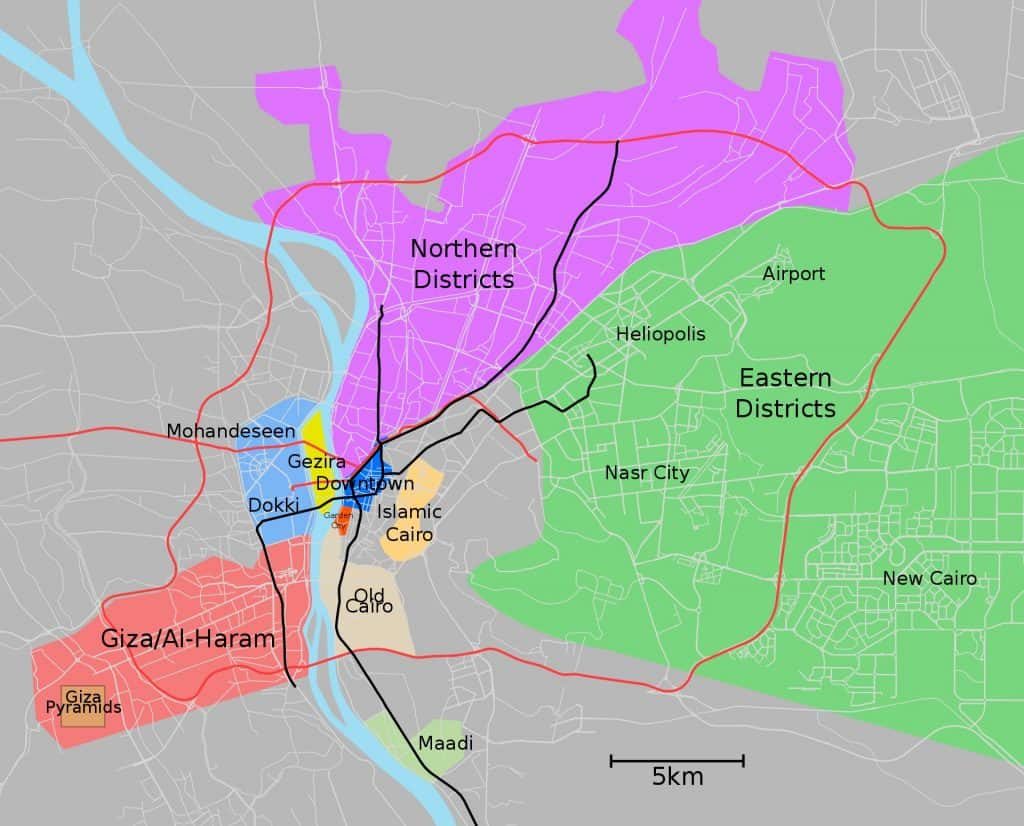
                          After three weeks at Heliopolis, Mack the Glaswegian and I were sent to a camp some way outside Maadi, a little European suburb on the other side of Cairo. The following is the text of a letter I sent to a friend just after our transfer to Maadi:

Dear George,

                          Casting an eye through the little notebook which is my record of letters received and sent, I suddenly realise that for more than a fortnight I haven’t sent you any news of Cairo, city of clean, well-dressed ‘effendim’, whom one would take for Londoners but for their darker complexions, and of filthily clad ‘fellahin’. City of shining, luxurious motor cars, and of screeching, wooden seated trams, crammed with those same clean-as-can-be gentlemen, and with tattered Arabs who shave once a week, wash once a quarter, and change their clothes once a year.

                          Since there is no actual news to send you, the idea occurs to me to describe to you the journey from our camp to Cairo. Our camp is a sandy area dotted with wooden huts. Above us is a vaulted roof of blue sky scattered with white, furry clouds. Where the corrugated iron roofs of our barrack huts touch the wooden walls, one finds nests of chirruping birds. The chatter of these feathered friends awakes us in the morning, and with it is intermingled the quavering, oriental chant of a sunburned young man as he goes happily about his daily chores intoning an Arab love song. This young man is a seeker after baksheesh by the name of Abdul, who comes every day to sweep up the floor.       

                          Let’s imagine that we are leaving the camp. Before reaching the guardroom, you see on the right a long, stone building. This is the dining hall, and outside sits an Arab selling tiny specimens of fruit whose high quality he advertises by yelling continuously and at the top of his voice: “Gigantic bananas!” Near him there is a young lad who sells newspapers, and who, if you give him a note to change, always gives you back the wrong money. But nobody ever gets angry. You have only to ask him for the missing ‘ackers’ and he will produce them for you with a friendly smile.  

                          “We carry straight on past the dining hall, and arrive at the guard room. This is an imposing building, even though it consists of only one storey. The brick wall is brilliantly whitewashed, and at the door stands the soldier on duty who, at first sight, also seems to be brilliantly whitewashed. However closer inspection restores the reality, and you observe that the illusion is caused by the whiteness of the guard’s webbing, revolver holster and gaiters, which have been blancoed assiduously to a glaring snowball hue.

                          The guard room is the epitome of British army bullshit which, as has so often been observed, will frequently baffle brains. And so it turns out. For completely unknown to the Colonel-in-Charge and the other big brass who think they run the show, Arab workers in the camp are very much impressed by the efficiency of the guard room personnel who lift the boom gate to allow them to come to work each day.     

So much so that they make presents to the guard for lifting the gate. These may be by way of free passes to the picture show, extra sugar for the tea, a gift of a hand of gigantic bananas, or even the introduction on special occasions of an attractive young Egyptian lady into this all-male preserve.

                          How wonderful it is to give baksheesh, for it benefits him who gives, as much as it benefits him who receives.

                          The guard raises the wooden beam, painted black and white and gleaming in the sunlight. We stroll under the barrier with a nonchalant acknowledgement. Then we are free – free of the camp, on our way to Cairo, and provided we keep out of the way of the redcapped military police, (locally known as ‘The Gestapo’), to all intents and purposes free for a few glorious hours of the army.

                          We walk along a dusty road, cross a railway track, and find ourselves in the village of Maadi. Somebody told me when we first came here that the syllable ‘aa’ of this word was identical in sound to the braying of an ass. I heard one such animal in good voice in Cairo the other afternoon, and the sound is indeed exactly the same. When he and I were discussing this small point, a teacher of languages remarked that Arabic was a tongue of animals – of camels and of donkeys. The French population write – and say –  ‘Méadi’, which is nearer to the correct pronunciation than the English loosely drawled ‘Mahdi’.

                          Maadi is made up of very clean villas, and its inhabitants are split up more or less equally into English, French and Egyptians. The spick and span villas remind one of the houses that fairly wealthy people in any European country are likely to possess. But one feels an inexplicable difference. Perhaps it is the fact that nearly all the roofs are flat, or that the houses are generally of white cement. Perhaps, again, it is that they nearly all have wooden shutters, French fashion. The dazzlingly bright sun gives them an indefinably different appearance, like the black and white pictures – a little too black and a little too white for reality – that one sees on the cinema screen.

                          After about half a mile, the straight road reaches the railway station, a cement platform covered with sand. Arabs abound, several of them competing to clean the shoes of whomever approaches, asking three or four piastres at first, but lowering their prices even to half a piastre in their haste to do trade before the train arrives. Mixed in this strange crowd, several Europeans in civilian dress stand elegantly.

                          At the ticket office, one must always buy a first class ticket from the clerk who is dressed in a khaki drill uniform and a red fez. The carriage next to the engine is first class; its seats are leather covered. The other three coaches have wooden seats, and the characters travelling therein can hardly be called clean. Mostly they are a poor, ragged, filthy, pitiable lot.

                          It’s a cosmopolitan crowd that the train pulls towards Cairo. You see bare-footed natives wearing the long robe – generally white – known as the ‘galabieh,’ and the red fez, or sometimes a small circular cap, upon their heads. A few wear down-at-heel shoes. Even those Egyptians who dress European fashion and seem to have copied our every garment still wear their country’s fez. It is the fez which is victorious here, the only garment, so to speak, which holds out against the advance of the occident. I have seen a few Europeans with trilby hats, many with light straw hats, but the bowler, heaven be praised, is conspicuous by its complete absence.

                          The poorer native women, that is, the womenfolk of the fellahin, always go bare foot, and are swathed in a kind of black all-enveloping robe. Generally they are veiled to the eyes, but despite this, one can as a rule gain an impression of their faces. Notwithstanding the privacy imposed by their mode of dress, it is not uncommon to see one of these women sit down on a public bench and pull out a breast to feed her young child, in full view of anyone who may be passing. The apparent inconsistency is no doubt due to our residual Anglo-Saxon prudery.

                          The wives and daughters of the richer Europeanised Egyptians dress as we do, and very often in the height of western fashion. Are they attractive? They most certainly are, may Allah forgive me, and when I observe them from afar, I often feel the hot blood of youth boil madly in my veins. Yes, the human race is indeed one: a maid is always a maid, wherever one finds her, and quite evidently a man is always a man.

                          The train creaks into movement and leaves Maadi. We rattle across yellow, sun-beaten desert. Often a band of green, cultivated fields follows the railway track on either side. A warm breeze enters through the open windows; the train whistle sounds joyfully and almost continuously. Voices discuss in Arabic, French, English, Greek, Italian – even in Polish, for we have many Polish soldiers stationed in the neighbourhood of Cairo. One hears every possible language. A fuzzy-haired Melanesian from the outermost Pacific island group would not feel out of place in Cairo’s cosmopolitan atmosphere.

                          We begin to pass tumbledown hovels which are almost visibly collapsing and crumbling away, but which shelter innumerable Arab families. Then we come to the modern little railway station of Bab-el-Luq, which is the terminus of this line. We leave the train and give our ticket to the blue-uniformed official who stands at the exit gate, and whose fez, perched jauntily on his head, leaves the tassle to dangle and dance above shining black eyes. We decline to buy from an Arab lad a paper-backed copy of “Snappy Stories”, the cover of which is embellished by the picture of a nearly naked lady with a wickedly seductive smile. We descend a few steps, and we are in the street. The sun drenches the pavement in warmth and golden light. Dark-skinned urchins run hither and thither. The drivers of ultra modern American taxis seek us as fares. Coachmen from horse-drawn gharries call to us. ‘Hey, Jock! Effendi! Take you to the YMCA? Very cheap!’

                          We carry on straight along this street of native stalls and shops. To the left is an Arab bistro with people inside drinking at dirty tables and smoking hookahs they have rented. On the wall, behind the counter, are hung several more of these ‘hubbly bubbly’ pipes for the delectation of anyone who cares to pay a piastre or two. This bistro has always attracted my attention, for the proprietor’s radio, perched above one corner of the counter, ceaselessly screams out Arab songs, sung by a sobbing, whining voice, which breaks off at the oddest moments, apparently in mid-phrase, and rises above the chatter and shouting of the crowd.                                                    

                          At the end of this street one finds the tramway and the tall buildings of modern Cairo. Near here also is a dark alley where I was accosted the other evening by half a dozen pickpockets, who seemed to appear from nowhere. There was something of a running fight, but I managed to reach a well-lit boulevard before things became desperate and without losing any money.”

Jim

Ch6 Pt3 Egypt 1946 first impressions.

The next morning, those of us who can keep any food down are queuing along the upper deck, waiting our turn to descend to the mess deck for breakfast.  Here we learn that one of our three engines is useless, and that one of the screws has broken during the pitching and tossing of the night.

After breakfast I go up on deck again and see to the starboard a mountainous island rearing itself from the sea, an island encircled by cloud, gloomy and menacing. Corsica! The island of Prosper Mérimée and of Guy de Maupassant who wrote such bloodthirsty tales about Corsican vendettas; the home of that military and administrative genius and scourge of Europe, Napoleon Bonaparte; and of that “other Corsican”, the singer Tino Rossi. No doubt Corsica is a beautiful island, but today, looming and misty, it has an air of menace.

Towards midday the sea began to get extremely rough again, and become more or less calm only at twilight on the third day, when we were sailing between the green, hilly coast of Italy and the island of Sicily. Here, in nineteen forty-three, the allies had successfully completed the invasion of Sicily from North Africa. Then they and the Germans gazed at each other from opposite sides of the narrow Straits of Messina, poised ready to spring at each other’s throats.

Some members of the ship’s crew told us that this was the roughest crossing of the “Med” they had ever known, and we could quite believe them. Nevertheless, we had periods of relative calm. At these times, it was good to promenade the deck and look at the immense expanse of sea, really blue now, whose billowing, white-crowned waves leapt and pranced as far as the eye could reach. Sometimes, when the sun shone and the skies were swept clear of clouds, it was most pleasant to lean on the handrail and look at the turbulent, foaming water cut and flung aside without mercy by the bow of our ship. I shall always remember one night when I had climbed on deck to get a breath of fresh air. It was pitch black. The sea and the sky were fused together in one single mass of darkness. Only the beat of water against the iron body of the ship could be heard. A few squares of light, escaping from the cabin windows illuminated, from time to time, foaming whirlpools, or white, threatening waves. Then, from the other end of the deck, men began to sing. Others joined in. And suddenly it was a wonderful blend of deep, melodious, all-male voices, and of the hissing passage of beaten, foaming sea. Everything was in rhythm. The soft wind carried away my cares, and nothing mattered in the world except the beauty of that moment.

At about ten o’clock in the evening of the sixth day, we saw to starboard twinkling points of light. Over there lies the coast of Egypt, and we are approaching Port Said. The acolytes of the engine room have had their work cut out on this voyage. They have worked frenziedly, but rumour has it that despite their efforts two of our three engines have failed, and we have sprung leaks in three places. Certainly we are visibly lower in the water, but all’s well that ends well. In half an hour we are at Port Said, the motors stop, and we drift with the calm, black waters shimmering and sucking at the sides of our ship. Opposite, on shore, are myriad lamps throwing a wan light on deserted streets. They illuminate monstrous cranes and send a thousand reflections jumping and glittering across the rippling water.

Sirens sound. Busy little bum-boats approach us. I see for the first time an Egyptian wrapped in a garment like an outsize white nightshirt, which I later learn is called a galabieh, with a red fez on his head. But the illusion of a dignified, mysterious oriental world is shattered when an Arab vendor, who has failed to sell a soldier a leather handbag, gives vent to his disappointment in very colloquial Anglo-Saxon English, making me believe that his command of ‘four-letter words’ is possibly equal to my own. Ah, well, it just goes to prove that English really is the true international language.

Although it is night, the wind on my cheeks from the neighbouring desert is warm. When are we to disembark? Nobody knows. In the British army you get used to waiting for somebody else to make decisions for you. However, this is my first journey outside Europe. I’m in no hurry, and it is pleasant to watch the Arab vendors who have gained access to the deck, and a conjuror who gives a ten-minute floor show for suitable remuneration and produces small day-old chicks from the most unlikely places.

Eventually we disembark at two o’clock in the morning. Our large valises are strapped to our backs; our small valises are on our hips. For portability we wear our thick great coats under our webbing. We hump our heavily laden kit bags on our shoulders. Sweating and cursing we cut across the quay, file between shadowy bales stacked one on top of the other, and scramble aboard an Egyptian train waiting in a siding.

During this time a few very young soldiers, who haven’t kept up with our group, lose themselves after leaving the “Empire Battleaxe”, get tangled up with a completely different group of soldiers who are leaving Egypt, and finish up in another ship. This sails triumphantly into the wide blue yonder carrying our friends back to dear old Blighty! We hear nothing of them until several weeks later. Having sailed the length of the Mediterranean three times, they finally finish up at our camp in Egypt, where they should have arrived the first time. That’s par for the course with the British army – everything in a state of absolute and continuous chaos! God only knows what the pay clerks costed their wages to!

Fortunately my own small party reached its allotted railway carriage with no difficulty. I fell asleep on a wooden bench in the long, grey coach in which I found myself after having unhooked my corset of webbing and let everything fall to the floor.

When I awoke, dawn had broken, we were rattling along at a fine speed, and it was surprisingly cold for a tropical country. It was February and still mid winter. Through the windows we could see the yellow, undulating desert. But there were wide lengths of greenery close to the railway, and tall, soaring palm trees dotted the adjoining landscape. Often we passed tumbledown, seemingly half-completed dwellings, on whose roofs were untidy piles of straw, apparently placed as protection against the heat of the sun.

At this hour Arabs were leaving their hovels like animals quitting their caves. Men enveloped in white, burnous-like galabiehs and muffled to the eyes because of the cold, travelled astride small, trotting donkeys. Each was followed by his wife – on foot! – swaddled in a black shawl and generally veiled. Sometimes, the donkey was replaced by a slow, ugly, incessantly nodding camel. One could not fail to notice the abject poverty of these “fellahin”, and this never ceased to appall us during the whole of our stay in Egypt. There seemed to be the very poor and the very rich, with only a small and insignificant middle class.

Towards ten o’clock in the morning it got very hot. Off came greatcoats, and tunics were unbuttoned. The country became bare, dry and uninviting. The trains stopped at several stations, and hordes of vendors descended on us. The technique was for them to approach us slyly and to show suddenly a glittering ring, which they would immediately hide again in a dirty palm. How much? – Two pounds, effendi. A real bargain, oombashi. After the usual haggling, of course, these prices would descend spectacularly to something in the region of five piastres – a shilling.       

Then sellers of oranges, (stolen from roadside groves), would do their best to make a quick turn at our expense. Or banana sellers would clamber aboard, and there was a temptation, for bananas had not been available in England for years. Unfortunately or otherwise we had received no Egyptian money as yet, and very few of our lads had any English or French money left. One thing that surprised us was the fluency with which these dirty, apparently uneducated natives spoke English. Doubtless their range was narrow, but within that range their fluency was perfect. They had, of course, learnt the language by ear, and their grammar was more often than not at fault, but here was a demonstration if I ever saw one of the necessity for linguistic back-up in foreign language teaching, and of the poverty of book teaching if that linguistic back-up is omitted.

At about one o’clock in the afternoon, the train pulled into a siding and we got out. We clambered into lorries, passed through the outskirts of Cairo, and arrived at a reception camp on the edge of the suburb of Heliopolis. The Greek name was well given, for the sun beat down from a cloudless sky and glared back from the white walls of the stone buildings. The lorries stopped, vomited men with their heavy kit and clattering hob-nailed boots, then moved off as each soldier set about finding an empty space in the sea of white tents which covered a plain of sand.

http://www.bl.uk/onlinegallery/onlineex/maps/africa/zoomify136595.html

[Above is an interactive map from The British Library Online, showing an array of allied sites in Cairo in 1946, and where the troops may or may not go.]

We stayed at this camp for three weeks. There was little to do except scrub one’s packs and webbing with sand and water until they were white. An Arab would be only too pleased to perform this enervating task for a couple of piastres. We used to spend the evenings on the canteen terrace, drinking tea from glasses made from beer bottles, chatting and writing letters.

At this time the Anglo-Egyptian Treaty governing the British occupation was up for rediscussion. There was much talk about this in the newspapers. The better class of Egyptian – the effendim – did not seem particularly anglophobe. No doubt they realised which side their bread was buttered and understood the vast amounts of British currency keeping the economy afloat. But a few louts from among the fellahin used to wait for us in the guise of boot blacks at the entrance to the camp. Thus, whenever we were going into Heliopolis or Cairo we had to run the gauntlet of these fellows, who would approach us pretending to want to clean our shoes. These were always dirty after we had trudged across the sand to the gates. To accept, however, meant that one’s trousers would be smothered in boot polish. We were officially forbidden to resist these people, however much they pestered us, thus cracking a few heads with some sticks and putting an end to the matter was out of the question. However, we used to go out in groups, and if a bunch of Arabs became threatening, there were always a few large stones around which we could pick up and look as if we were prepared to use – as indeed we were. Thus a number of ugly incidents, which blew up from time to time, always seemed to peter out. 

The native shops and stalls, the bistros with their tables scattered across the pavement at which Arabs – some dressed in galabiehs, some European fashion, but most wearing the ubiquitous fez – sat drinking coffee and often smoking hookahs, had a great interest for us. This was unfortunately marred by the hostility we encountered during our first days in Egypt.                                               

Another pastime of the Arabs in the vicinity was to organise raids on the camp. At night, they would cut the barbed wire which marked the perimeter, quietly enter the tents, and steal whatever they could lay their hands on. A rifle was worth twenty Egyptian pounds, a small fortune for a fellah, which was one of the reasons why the arms of all British forces in the Middle East were kept in locked armouries when their owners did not need them.

Ch6 pt2 Toulon and the Empire Battleaxe

I shall always remember Toulon as a yellow town. The palm trees were quite frequent and exotically noticeable to an English eye. As we approached the outskirts of the town the yellow became more pronounced. Every single house seemed to be yellow. The earth was yellow. Even the buds on the trees and plants were yellow. A yellow landscape. At length we drove into a camp of military huts – it was called a camp, though recent rain had turned it into a yellow bog.

I went to get my hair cut by one of the French barbers – nothing like talking to a barber to get the lie of the land, and we had an interesting conversation for about half an hour. That afternoon, I succeeded with several other comrades in extracting myself from the marsh of gluey clay – which was our camp – and we were free to explore.

We stopped a small, broken-down lorry on the road, and perched atop the drums of smelly swill it was carrying, we rode in triumph to the outskirts of Toulon. We got down to finish the last kilometre on foot, thanked the smiling men who had given us a lift, and began to walk. Civilians passed us, hardly sparing a glance for us foreigners, so used were they to meeting us. But the tongue they spoke was familiar to me and from time to time I caught snatches of their conversation. I experienced that peculiar feeling of empathy I have always had whenever I have had the good fortune to visit France. I felt “at home.”

As we came into the town, we saw a tram – two carriages, one pulled by the other, and no “upstairs” such as we were used to in England. The tram was just starting. We began to run, and jumped aboard. The conductress asked us where we were going, and I commenced a long conversation with her trying to find out the geography of the town on behalf of our group.

Near the town centre we left the tram, and for a few moments watched a group of men playing “pétanque” on a gravel patch by the roadside, quite oblivious of passing trams and motorcars. We cast around for something to eat, but restaurants were out because food coupons had to be given for meals. We stopped at a stall near the pétanque players, where we bought bon-bons and dry biscuits from the woman in charge. Cars passed ceaselessly, trams were grinding and groaning. Everywhere one found typical French cafes, with tables and chairs scattered about the pavement and people seated at them, enjoying a glass of wine. This was the civilised way to live!

It begins to get dark. Shop windows become filled with light. No more “blackout”. How wonderful that is. Towards eight o’clock, after having strolled here and there, we discover a little bistro in a side street. The proprietor is very pleasant, and we make the acquaintance of his sister, a charming lady, and of her son, a kiddie of three or four years old who is called, so he prattles to us, “Pierre”. One day I shall call my own son by this name, but that is a long time off. We take a few glasses of Eau de Vie de Marc, a strong white liquid which the “patron” tells us is the nearest thing he has to whisky. At the end of the evening we leave the estaminet with many fervent declarations of friendship. We catch the last tram, leave it on the outskirts of town, and then succeed, despite the late hour in begging a lift on a military lorry going towards our staging camp. The lorry, which is bound elsewhere, sets us down behind the camp, so we have to climb over a high, barbed wire fence with a ten-foot drop on the other side. No problem for old sweats such as us, especially after having enjoyed excellent French hospitality for most of the evening. 

The following day the results of our splurge in the estaminet make themselves felt, and we suddenly discover that we are short of money. This was a situation that had to be rectified. With unaccustomed foresight I had brought with me a spare blanket, scrounged from the quartermasters store in England. Two comrades had similarly provided for themselves. It was merely a matter of finding someone to buy our blankets in exchange for silver to cross the palms of avaricious shopkeepers. We left early in the afternoon with this mission in mind. 

Near our camp stood a small estaminet where one could drink at rickety tables in a small back room. The proprietress, so rumour ran, had started off by selling wine in the usual way, but had climbed somewhat in the world. At the time of our stay in the district, she found herself at the top of the social ladder, being a Buyer of British Military Blankets. These blankets were, of course, ‘half-inched’ from the quartermaster’s store by the rough and licentious soldiery prior to being flogged to Madame. It was this lady, then, whom we had chosen to be our benefactress. 

We therefore shrouded our blankets in greycoats and set stealthily off, like grave robbers carrying corpses out of a cemetery. We succeeded in leaving the camp without raising the suspicions of the sentry at the gate, and arrived at our chosen bistro. This gem in the heart rural France was a tiny cottage surrounded by green and bathed in sunshine. There were four of us, and we all had blankets to sell, except my mate Mack, who was temporarily rolling in money, having persuaded some gullible person to buy his wristwatch.

Garcon – a glass of white wine each before getting down to business – and Monsieur Mack will pay. (He has agreed to finance the group until our fortunes take a turn for the better).

The wine suitably swallowed and savoured, I make enquiries about Madame for it is a blue-jowled gentleman who speaks French with strong Italian accent who is serving us. Madame? She’s out doing the shopping, but she will be back very shortly. In the meantime, would the gentlemen care for another drink? Well….. why not? Mack is paying. But yes, certainly, the same again. Fortunately Madame arrives just as we are sampling our second drink. Good day, Gentlemen. In what can I serve you? In examining some blankets which we have acquired, Madame. Ah, blankets. C’est bien ca. Faits voir. Let’s have a look.                                                          

We display our wares. She fingers them. Her friendly smile becomes pitying, finally disdainful.

“Eh bien, madame?”

“Gentlemen……what can I say? These blankets are…….’moches’. They are absolutely rotten. I could not possibly buy such blankets. They are made of cotton.”

Consternation. Our benefactress had turned into an ogress. Frantically we sing the praises of our army blankets. These blankets are specially made to keep British soldiers warm and fighting fit. How can she say that they are made of cotton!

She fingers them once more. Contempt and scorn fight to gain control of her curling upper lip. Finally she says, “I should be mad to buy these cotton blankets. But…..you are British soldiers, so I will buy one blanket only.”

“One blanket only? But the others are of fine quality, madame.”

“That is not true. They are made of cotton. I will buy one only.”

Her mind is made up. We leave, having each drunk two glasses of wine. After paying for the booze we don’t seem to be much further ahead. We have sold one blanket and we have two to go.

We direct our discouraged footsteps towards another rustic pub, just by the bus stop. A small, dark haired man receives us. We wash out the dust, which has gathered in our throats since the last bistro, with a glass of beer. The bar tender sees our blankets and asks us how much. What does he offer? – A hundred francs apiece for blankets of that quality. – But that’s daylight robbery. Look, Monsieur, see how nice and soft these blankets are. We might……we just might……consider a hundred and fifty francs apiece, but even then you’d be getting them very cheap.

He scratches his head. It is a hard decision. Would we care to buy another glass of beer each while he makes up his mind.

“All right. But wait, when does the bus for Toulon arrive?”

“Not for half an hour yet.”

“But Madame at the other bistro said it was almost due.”

“Mais non. She must have made a mistake. Another beer?”

“We…….ell…….”

“I will pour it out. The order is four beers, eh, messieurs?”

At this moment the bus drives up. Ah, the horrible liar. He is on the point of pouring out the beer. We hurriedly cancel our order, dash out and climb aboard the bus, blankets unfolded and higgledy piggledy. Quelle pagaille! We have to stand in the bus and get in everybody’s way as we try to bundle our blankets up into our greatcoats and reassume some sort of dignity.

The bus enters Toulon and comes to a stop. We leave and lose ourselves in the little streets, which descend towards the harbour. Even now the masts and funnels of the huge, scuttled French Fleet protrude, mournful and sad, above the waters. After some prodding from my friends I approach a housewife who is standing at the door of her house and say to her in my politest French:

“Madame, would you have the kindness to indicate to me the road by which we may arrive at the black market?”

She looks at me as if I am crazy. Hurriedly I explain that we have some blankets to sell, and she gives me complicated directions. We follow them as best we can and finally arrive at a block of dirty grey cement houses, several stories tall, and seeming to form a separate quarter of narrow, cobbled alleys. On the wall facing us is painted a notice: ENTRANCE FORBIDDEN TO ALLIED TROOPS. The neighbourhood seems deserted as we cross the threshold of this new, mysterious corner of Toulon. We turn into another alley on the left, and suddenly we discover a dozen men behind us who have appeared from nowhere. An Algerian wearing a fez asks us what we have to sell. We show carefully, prudishly, almost shamefacedly, like young ladies of the Victorian era giving a glimpse of their ankles to infatuated suitors, the corner of a blanket. But abruptly someone else pushes the Algerian aside and plants himself in front of us. He is a tall, thin man, well-dressed and handsome in an effeminate way. We talk; we haggle. The Algerian has vanished. We have nearly concluded a deal when a thickset, loutish man, dressed in a ragged military jacket and baggy military trousers, who has obviously not shaved for days, pushes himself forward, feels the blankets, and announces in a voice of authority: “These are lousy blankets.” There is silence. The thin, well-dressed man becomes doubtful, is suddenly undecided.

I say: “Of course, Monsieur, you may refuse these blankets if you like. That is up to you. But I assure you that their quality is of the first class…….”

Someone whispers something in the thin man’s ear.

“Tiens!” he exclaims. “Un flic. Blimey, a ‘tec.”

It is a magic word. The crowd thins. In next to no time the alley is once again completely deserted. We might have dreamt the meeting. Where the “flic” is, I have no idea. We see nobody.

Since our customers have gone, there is nothing to do but quit this quarter of tall, grim, houses. We retrace our steps, turning over in our minds the possibilities which remain. The whole exercise has been most discouraging, and the general opinion is that we must be realistic. Quite clearly the local market for blankets has been over supplied by British soldiers. The Blanket Boom has burst. The market is very bearish with regard to blankets. It is not a seller’s market any more, and to be honest, our blankets are somewhat threadbare, and anyone wanting to buy them must be hard up indeed. What are we to do?

Somebody suddenly has a brainwave. Suppose we give them to Madame, mother of Pierre, who was so hospitable to us yesterday evening. Why not? We’ve walked enough, and we want to take a weight off our legs. We each buy a large sandwich at one of those “baguette” sandwich stalls, and then direct our steps towards the swing doors of the bistro where we have spent the previous evening. Madame spies us through a haze of pipe and cigarette smoke and serves us with beer. Little Pierre sits down with us, and one of the lads gives him a bar of chocolate.

We have put down our greatcoats on another table with the blankets rolled inside them. I am supposed to make the presentation to Madame with an appropriate little speech. I rise to do so – and two gendarmes enter. I sit down again. Mustn’t incriminate Madame before these bloodhounds of the law. We wait half an hour, but the bloodhounds, who have all this time been engaged in animated conversation, seem set to stay all night. We decide to leave and come back later.

After ten minutes’ walk, we come to a fair ground, and stroll along looking at the stalls. One of the lads nudges my arm and asks, “See that bloke looking at us?”

I turn. A thin, unshaven man, with a waggish expression smiles at us from behind the counter of his stall, then points suggestively to our greatcoats. I go up to him, feeling rather annoyed. Is he trying to be funny?                                            

“Well?

“Well, what have you to sell?”

That, of course, is different.

“Two blankets.”

“Let’s see.”

“With pleasure.”

Rapidly the blankets disappear behind the counter where the fellow feels them, judges them.

“How much are you asking?”

“A hundred and fifty each.” 

“Ça va. It’s a deal.” He searches in a greasy wallet. “Here’s three hundred francs.”

Confound it. I might have got two hundred francs each if I’d only asked. Still, never mind.

“Thanks,” I tell him.

“De rien, mon vieux. Don’t mention it.” He extends a filthy hand, which I shake enthusiastically for the sake of the Entente Cordiale.

“And if you’ve got anything else, Monsieur, anything – understand? – come and see me. Come and see me!”

He smiles fraternally, exposing tobacco-stained teeth, as if this underhand deal is a transaction of honour between two gentlemen. I disengage my hand, and we leave the bright lights, the raucous music and the cries of the fairground behind us.

The following day we got up early, boarded awaiting lorries, and drove through a thin drizzle to the harbour. In single file we made our way aboard a large, rusty ship called The Empire Battleaxe, and waited. Towards nightfall we put out to sea. A mist lay about the bay, half hiding the town. Au revoir, France. See you again soon, I hope. Who was it that said the waters of the Mediterranean were blue? The waters are grey and sullen, the rain dribbles down, and I suddenly feel fed up with this pointless military existence I am forced to lead.

I go below and search for the bed graciously provided for me. It is a piece of canvass stretched across a folding steel frame – one folding shelf amongst several hundred others – and I try to sleep. Towards midnight as we get well out to sea, the Empire Battleaxe, which seemed so big in harbour, starts to pitch and toss like a cork. I find that this has little effect on me if I lie still and compose my mind. But many of the lads get up, caught by the diabolical agonies of sea-sickness, stagger to the lavatory, and have a good vomit. Unhappily there are many who don’t make it as far as the ‘loo’, and as the night wears on, anyone who walks between the beds is well advised to do so carefully and watch where he puts his feet. The engines pound sonorously when the propellers are in the water, whirr in a frenzy when the stern is lifted on the crest of a huge wave, and turn madly in the empty air. We are clearly having a most unseasonable passage.

CH6 Pt1 Recovery then Egypt via France.

After spending six weeks at an American transit camp in the small town of Weissenfels, I was flown, cooped up in an uncomfortable aircraft, to London. I had weighed a little under eight stone when the Americans had liberated us. However, they were most hospitable and kind, and fed us well. I looked quite healthy again when I got back home.

I had only been in England for a few short days when I was sent on indefinite leave. But either my friends were in the services or they had grown away from me. Also I was experiencing that peculiar, disheartening feeling which soldiers have when the war seems to be suddenly over, but they have not yet been returned to civvy street. It is a time of frustration when the excitement of ever-present danger has disappeared. Yet it is also a time of self-doubt and fear of one’s ability to cope with the problems of civilian life.

However, there was still a war on in the Far East. Germany and her European allies were beaten, but perhaps I could rejoin the First Airborne Division, who had been sent to Malaya in preparation for the onslaught on the Japanese islands. I wrote to the OC First Airborne Div Signals asking to be taken back on the strength. I later heard that some of my old mates had had the letter read to them. However, there was no way anybody was going to make a special effort to fly me out to Malaya. But, of course, I did not know that at the time.

The crowded streets and dirty buildings of London were becoming intolerable to me. I had a feeling close to claustrophobia. I tried to get myself recalled from leave so that I could resume my service with the army.

I now had the utmost difficulty in getting myself recalled from leave. The army had successfully disposed of me and no longer wanted to acknowledge my existence. But eventually I succeeded, only to find myself sent to a rehabilitation camp for ex prisoners of war. Here army instructors insisted on teaching me all over again how to fire a three-0-three rifle, despite the fact that I had been firing rifles for the past four years. I also learnt anew how to stand to attention, stand at ease, dress by the right, and most importantly, how to “salute the officer.” (Longest way up, shortest way down, fingers together, at the correct angle, almost touching the base of the forage cap). I suffered this very important training for several weeks. Then began a series of shifts from one camp to another during which my chief duty was to peel potatoes.

It was at one of these camps, on the racecourse at the Yorkshire town of Thirsk, that we learnt one day that following the atomic bombing of Hiroshima and Nagasaki the Japanese had capitulated and World War Two was finally over. I am quite sure that we all realised that an era in the history of mankind had finished and that a new and vastly more dangerous one had begun.

By now the pointless fashion in which I had been sent hither and thither had thoroughly annoyed me. Demobilisation was to be extended to avoid a glut of ex-soldiers on the labour market and consequent industrial problems. The fact that I had a job to go back to at the London County Council made no difference. I had at least another year to serve in the army. I therefore resolved to spend it abroad at the army’s expense.

Eventually, after making a nuisance of myself to everybody, I reached a drafting camp outside Newcastle on Tyne. No sooner had I arrived, however, than they stopped sending men to the far-east, and I found myself on a draft to Germany instead. At that time Germany was the one country I did not wish to revisit. My sojourn there as a prisoner had been too recent, and my memories were still bitter. After a prolonged interview with the OC of the camp and frantic negotiations with a comrade to take my place, I finally got myself on a list for a posting somewhere further east.

The war with Japan had been over for a number of months now, and rumours began to circulate that the camp was going to close down. Finally a special order came through that all ex-prisoners of war were to be sent on special Christmas leave, and I journeyed south to London, although I would far sooner have stayed behind.

I came back in time to discover that a further draft – probably the last – was being collected. I was friendly with the sergeant clerk in the company office and with the Company Sergeant Major, and thanks to their influence I was included in this batch of young men who were being sent through France across the Mediterranean to Egypt. They made me a corporal at this stage, as one of the more case-hardened old sweats in this young band of hopefuls. It was the dizziest promotion that I ever obtained in the British army. I was reduced to the ranks some six months later, as I shall relate in due course.

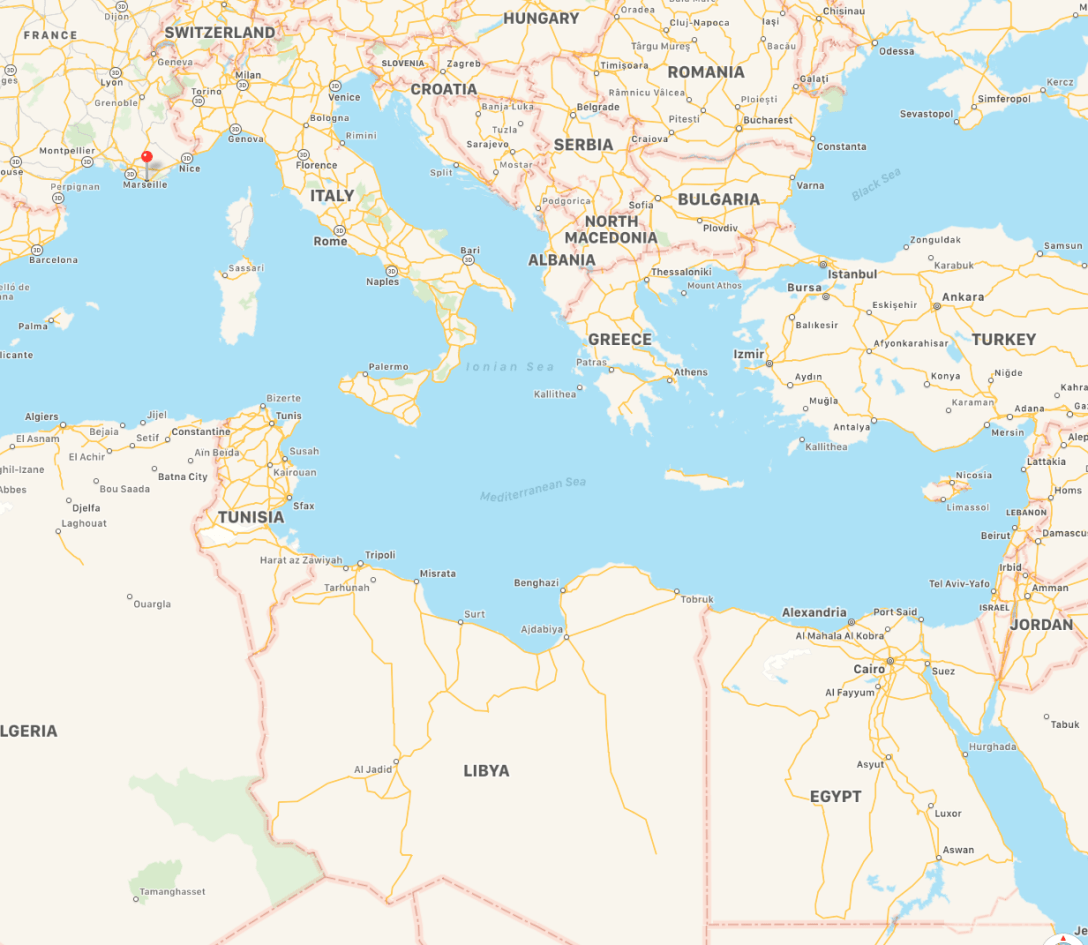
We gathered together on the parade ground one evening, kit-laden and sweating, and journeyed in trucks to the railway station. We spent the following night at a camp outside the twisty-streeted port of Newhaven, and early next morning boarded the sturdy little cross-channel ferry “Isle of Thanet”.

We remained half an hour below deck, awkward and clumsy with our kit bags, valises and life-jackets. Then the motors began to pound, and we set our bows seawards. I climbed on deck, and behind us saw a foaming white wake losing itself in the grey, choppy sea. The chalky cliffs of England, already indistinct, were sinking into the waters of the Channel. Every time that the bows of our ship cut the greyish-blue waves, every time that a little hillock of salt water drenched the deck, the droplets being carried right away to the stern by the cold wind, we were nearer to France.

France! I seemed to have spent half my short life learning her beautiful language. I had also known many of her people. And I had heard many heartbreaking stories of their exile. Yet how many dramas, about which I had never heard, had played themselves out in France during the four years of German occupation! Well, in a few hours we should be treading French soil.

Mack, from Glasgow, one of my new friends, leans over the rail, gazing back towards England. His wife had fallen pregnant to an American soldier. Mack loved her dearly, but had never been able to forgive this infidelity, and they had drifted apart. The memory of her tortured his mind. His reason for volunteering for the draft was to try to forget.

Mack waves sarcastically towards the disappearing shore.

“Bye-bye England. And a soldier’s farewell to everyone, you shower of rotten bastards.” 

I find there the echo of my own thoughts.

Towards midday we drew alongside the silent quay of the little port of Dieppe. This is where the Canadians made their abortive and costly landing in 1942, a rehearsal for the real invasion, which was to come much later. Chains rattled, a narrow gangplank was thrown out and secured by two French seamen in blue caps and jerseys. Then we disembarked and found ourselves in France, a little lost, heavy packs on our backs, and rifles to lean on. Presently some children approached uncertainly, like street mongrels, not sure whether they are going to be welcomed or chased away with kicks. The soldiers dig into their pockets, into their packs and into their gas mask cases, producing sandwiches, which they offer to the children. For the aftermath of war is still with us, the economy of Europe is broken, and food and shelter are at a premium. Chocolate, coffee and cigarettes are the international currency with which one can buy anything.

Some of our soldiers address the children in English, some murder French in the way that only Englishmen can, but communication is established with these hesitant, frightened youngsters. Clearly they see only armed soldiers and do not know what to expect. A kiddy of six or seven years is standing a few yards away from me, his eyes wide, a finger playing with his lower lip. I search in the pockets of my great coat.

“Come on, then. I’ve got something for you to eat.”

Something to eat! His eyes light up. He takes a few hesitant steps. But he is reluctant to come any further.

“Viens ici, mon petit. Don’t be afraid.” 

He comes a little nearer, never taking his eyes off me. During all his childhood his parents must have told him to avoid German troops who have been notorious for picking French people off the streets and sending them straight to forced labour in Germany, or for taking hostages in reprisal for the killing of German soldiers, standing them up against a wall, and shooting them out of hand. In his young mind, all soldiers must be suspect.

The child comes a little nearer, never taking his eyes off me. I have found a bar of chocolate and hold it out to him.

“Du chocolat. Tu le veux? Here, take it.”

We hold our breath, both of us. He is only a couple of feet away from me, but clearly he is scared. But he is tempted. Suddenly he snatches the chocolate from me, scuttles away and takes refuge near a pile of planks. He holds the bar of chocolate against his breast and looks at me, eyes staring, mouth open – a frightened sparrow.

I step forward, but suddenly he turns tail again. Never have I seen an urchin move so quickly. In a moment he has disappeared.

I look at the row of houses opposite. Their walls are still pitted by shrapnel – no repairs have yet been made. To the left, all that remains of a house is a heap of bricks and plaster. A solitary green shutter is still fixed to one wall, and hangs sideways, like a drunken man ready to fall, but clinging stubbornly with one hand. Railway lines run the length of the quay, but higgledy-piggledy, fantastically twisted, no good for anything any more. Maybe the war has twisted the minds of men in the same fashion. To the right a long, white chalky finger, surmounted by a lighthouse, points out into the Channel. How beautiful its whiteness must be when the sun shines, and the waves dance, and the seagulls fly about, at one moment skimming the joyful sea, at another circling the lighthouse.

But the sun is hiding sullenly behind grey clouds, and it seems as if some giant with an immense club has rained down blows upon this town. Dieppe, indeed, has been beaten and ravished by war, which gives death and ugliness in exchange for life and beauty. Even that pretty chalky peninsula is eaten through and through with tunnels, formerly the lairs of German canon, awaiting the approach of the British invasion barges. It is like looking at a beautiful woman whom you know to be eaten up from within by a loathsome disease.

The sky is moody over Dieppe. A cold wind begins to blow, but it cannot blow away the stink of death. This same stale odour pervades bombed habitations everywhere. Only time can cure this stinking illness.

We wait for half an hour, then a dozen lorries – those huge, roaring American lorries, painted grey and with the name of the driver’s wife or girl friend inscribed on the bonnet – come to fetch us. The lorries circle, drive off, and in next to no time we are leaving behind the houses with the picturesque shutters and the hilly streets of Dieppe. On the outskirts of the town, we enter a large camp – a patch of ground, which has been cleared of obstructions and planted with wooden huts. Here we eat in a big communal dining room where pleasant French women show us our places and wait on us. Afterwards we draw blankets and line up at the NAAFI for our rations of cigarettes. 

It is starting to rain as we begin to queue for four o’clock tea, and the dull sky hangs like a pall over the camp. We are happy to receive the order “On the lorries”, and to cross Dieppe once again, this time on our way to the station. The town seems almost deserted. Only a man here in a blue beret or a woman there running her errands glance at us, then turn and continue on their way.

Our train was standing in the station, but we had to wait two hours before it left. During this time workmen with the characteristic French blue beret walked up and down the platform, trying to buy English cigarettes from us. I had a conversation for about half an hour with a young man in his middle twenties who came into the corridor. He had just bought fifty cigarettes and was broke. He told me that the average workman in France received a thousand francs a week which was at that time equivalent to about two pounds ten shillings English, a very low wage. Potatoes, butter and bread, he told us, were rationed, and the cost and conditions of living were worse than under the German occupation. One was free, of course … followed by a Gallic shrug of the shoulders. In further conversation it turned out that he had been a prisoner of war in Germany for five years.

Our train gave a jerk and he quickly turned to get off. I stopped him.

“Attends. Tiens.” I gave him a packet of twenty cigarettes.

“But I have no money to pay you.”

“Forget it. We were prisoners of war together, n’est-ce pas?”

The train groans, moves. We hurriedly shake hands.

“Au revoir, and thanks for the cigarettes.”

“Au revoir, my friend, and good luck.”

He turns again and descends to the platform. I am so sorry for the French. God knows, we have suffered enough from the war in England. But the French were invaded by the Germans, suffered death and deportation during the occupation, then were invaded once again by the allies. It seems to have become the practice that in any European war France is always a battleground. Now once more they have a country to reconstruct. I do not envy them their task.

The windows of our coach had no glass, so we were obliged to improvise curtains from blankets and block up the holes as best we could. The fields outside were covered with snow, and as the train rattled along, a piercingly cold wind sought entry. We were soon bitterly cold, and the position was aggravated by the fact that the heating system had gone wrong between our coach and the one in front.

At every stop I got down, hunted out the stationmaster or the engineer and asked what the chances were of mending the break in the heating pipe. Railwaymen squeezed in between the coaches and made learned examinations. Promises that somebody would do something were given lavishly, and sympathy for us in our travelling refrigerator was extreme. Yet somehow or other the heating system remained useless until the end of the journey.

Camps had been set up by the railway track, and from time to time we stopped to have a meal in some huge barn in the country and to draw sandwiches and chocolate to sustain us on our further travels. At these stopping places, no matter how deserted the countryside, women and their children appeared beside the train, and it was to them that the bulk of our chocolate ration went.

We drew into Toulon at about eight o’clock on a clear, mild morning with the sun shining in a watery fashion. We followed a short, underground passage and found ourselves in the street, the object of curiosity of the passers-by. All traces of snow had disappeared, and a tall, slender palm tree signalled that we had arrived at the Mediterranean coast.

Ch5 Pt3 Paddy, cruelty, Freedom.

Paddy and I were loading a clay-tub at the quarry one day when he suddenly took off the old felt hat which he was wearing, flung it in a puddle, and with an unprintable expletive, uttered in a rich Irish brogue, announced that he wasn’t going to work anymore.

“But you must,” I said. “Otherwise they’ll clobber you.”

“Be Jaysers I won’t,” said Paddy, and threw himself full length upon the clayey earth. 

The Maestro saw us from afar and came hurrying over to our section of the quarry.

“Mensch! What’s the matter?”

“Ich bin krank,” said Paddy, holding his hand to his stomach. “I’m sick. Fetch a doctor.”

The Maestro was at a loss.

“You had better come with me to the hut.”

There was a hut at the end of the quarry, where we always ate our lunch. The Maestro helped Paddy there, and subsequently Wingy, looking more like the villain of the piece than ever with his slouch hat and evil smile, came hurrying towards the quarry to find out what the trouble was. Paddy complained of vomiting and pains in the abdomen, and suggested that he might have appendicitis. Wingy was sceptical. But after he had unsuccessfully tried to cure Paddy by kicking him several times in the ribs and other parts of the anatomy with the toe of his jackboot, he had to accept that a cut in his work force was inevitable.

Paddy was sent into Halle. There a South African doctor, himself a prisoner, who ran a clinic for POW’s, diagnosed appendicitis. Paddy went into hospital, and a fierce discussion raged for some days between learned English, German and Polish doctors as to whether his appendix was inflamed or not. Finally he was given a local anaesthetic, and he was able to watch with interest as the offending organ was removed. Of course, there was nothing wrong with it. But the operation was rather more extensive in those days than it is today. So Paddy now had a good rest in hospital until the incision healed.

In spite of everything, however, his plan miscarried. He had hoped that the war would be over in three months and that he would never see Wingy or the quarry again. Unfortunately the war was to last much longer, and Paddy returned to the quarry as a very reluctant labourer in Wingy’s workforce. 

“Flaming one armed penguin,” said Paddy, vengefully. “But I still conned the bastard, didn’t I?”

Our chief pastime when work at the brick factory was done was discussing rumours of the allied invasion of Germany. Thanks to my knowledge of French and some limited German, I became the chief purveyor of rumours. In the quarry were several forced labourers who, having given their promise not to escape, were allowed to go about more or less as they pleased. One of these was Stefan the Pole, who had not seen his wife and son in Warsaw for five years. He had access to a wireless set whose owners tuned in to London, and every morning he gave me news which he, in his wishful thinking, probably garbled somewhat, and which I, not always fully understanding, undoubtedly garbled even more. After each recital of Anglo-American and Russian successes on their respective fronts, I would ask:

“Stefan, are you sure this is true?”

And Stefan would answer: “Yes, it is true. Every word.” Then, lowering his voice conspiratorially, “English radio. English radio speak.”

Two other informants of mine were Piccolo and Mario, former Italian soldiers, now pressed into the unwilling service of the Reich. Piccolo and Mario both spoke good French, albeit with a strong Italian accent, and under the jealous eye of Wingy, who understood only German, they would pass on to me all the news they had picked up in the town.

Sometimes, too, they would bring me cooked sugar beets to eat. Sugar beets, indeed, threatened to become the staple diet of all of us.

At this time the sugar beet harvest in Germany was in full swing. Often Polish ex-soldiers used to drive ox carts loaded with it past our billet towards the railway. Then we would rush to the barred windows.

“Psst! Kamerad!”

Quickly the Pole would dismount, grab an armful of sugar beets and thrust them through the bars to us before the guard in the adjoining annexe had seen him. These sugar beets we used to bake in the barrack stove. A black crust would form on the outside which, when chipped off, disclosed a soft, sweet core. Unfortunately, too many sugar beets gave one a distended stomach and excruciating pains, for which reason Wingy had strongly forbidden their consumption. Thus our guards were always on the alert for the sound of an ox cart on the cobbles outside.

One day in the quarry I got a piece of grit in my right hand. The hand turned septic, and the inflammation spread up my arm. I was in considerable pain, but Wingy would not let me go to the doctor, telling me when we met in the factory one day, that I would shortly know, as he did, what it was like to lose an arm. As luck would have it, there was a new Feldwebel in charge of the Arbeits-kommando. I was finally sent to the sick bay in town with Pop. A grey haired old guard who was friendly with us all, although I never entirely forgot that he had joined in with everybody else in beating us up after the four of us had escaped from the lager. From the sick bay, I was sent immediately to hospital, with the message that I could possibly lose a finger. However, the German doctor who operated did a good job, and today the only souvenir I bear is a small scar joining the third finger and the palm of my right hand. The result of this operation, however, was that I spent several weeks with my arm in a sling unable to work. 

Soon after my return, a skipful of clay came off the overhead rail in the quarry and fell on my right hand, crushing my thumb and obliging me to spend several more unproductive weeks in the billet. Wingy, who heartily detested me, and whose feelings I reciprocated in full, therefore took the opportunity of transferring me and one or two other unsatisfactory characters, including Paddy to another brick factory on the other side of Halle. I guess it makes sense, if you have rotten staff, to transfer them to the opposition.

I never saw Wingy again, but later, when I was free, I passed through the town in an American truck. The Polish flag floated lazily over my former prison, and I wondered whether some foreign worker, ill treated for years by Wingy, had seized his opportunity and taken just vengeance.

The new brick factory to which I had been sent stood on a main road leading out of Halle, and differed very little from the one I had left. One morning, shortly after I had been transferred there, the town received its first serious air raid. The sirens wailed, we heard the spluttering of guns in the distance, and then the attacking aircraft came roaring in. They were American, and they flew over continuously for about ten minutes, never breaking formation. Bombs began to fall from their silver bodies just as they passed over the factory, and we could see little trails of vapour as they hurtled diagonally down to the centre of the town. There were many French forced labourers working beside us whose first sight this was of allied revenge, and they went wild with delight. After several minutes, the last bomb sped shrieking to earth, and the last aeroplane disappeared into the blue sky. But an immense pall of grey smoke was rising from the centre of Halle and spreading over the town.

That night, and on subsequent days, we were marched into town in a quite hopeless attempt to repair some of the damage which had been caused. For instance, they gave us shovels to fill in bomb craters that would accommodate a small house. Evidently the railway station had been the central target, for overhead electric cables had been ripped down, and the steel tracks were twisted fantastically above gaping bomb craters. But other parts of town had been hit also, and in one street we saw the mutilated corpses of men, women and children laid out by the civil defence authorities in neat rows along the pavement. Many years later I paid my first and only visit to the killing room of an abattoir, where the bodies of beasts are carried on meat hooks around the work floor while men skin them and then carve up the bloody carcases in transit. Only then did it occur to me that the expressions “charnel house” or “slaughter house” are the only terms to describe accurately the scene of bloody murder we saw that night by naphtha flares in the town of Halle.

Such is the nature of modern warfare.

A few days later, when we were working some way away, in the quarry, another alert sounded, and we retired with our guards to the little hut where the men ate their lunch until the all clear should go. Grimly I recollected London’s baptism of fire. Then I remembered how the inhabitants of Halle who had previously ignored the sirens now scuttled like bevies of startled farmyard hens for the nearest cellar marked “Luftschutzraum.” 

Suddenly Paddy’s voice broke into my thoughts, saying, “D’you mind moving away from the stove?”

He was speaking to a thin, irregular-toothed Czech, a volunteer worker who was regarded by everyone as something of a collaborator. The Czech had planted himself directly in front of the iron stove so that nobody else could see the fire.

“D’you mind moving, please?” asked Paddy a second time.

The Czech affected not to understand.

“D’you mind moving so that we can get warm as well as you?”

Paddy repeated, and made signs so that the other could not fail to understand, and was obliged to shift very slightly to one side.

“Thanks,” said Paddy, sarcastically. “It’s very kind of you, I’m sure.” He had never liked the Czech, who was a great tale-teller to his German masters, and I could see that his Irish temper was rising.

Suddenly the Czech said: “Ah, this terrible war. So many people are dead in Halle. Men, women and children.” 

“That’s the way war is,” said Paddy. “Dies ist Krieg, Verstanden? War is bad. Men, women and children – no difference in war. Impossible to make any difference – verstehen? The Germans have bombed us. Now we are bombing the Germans. It cannot be helped. Krieg – War.” 

The Czech looked at him through half closed eyes. Paddy was a small man, not physically imposing. The Czech spoke in clear, good German, thinking perhaps that Paddy with his mere smattering of the language would not understand him.

“What terrible destruction.” A sneer revealed his ugly teeth. “But then, what can you expect? Alle Englische Leute sind Schweinerei! All English people are swine!”

The last words, hissed spitefully, brought a sudden stillness throughout the hut. Everybody had understood perfectly. But while the rest of us were letting it sink in, Paddy was on his feet, his face chalk white with anger.

“What’s that? What’s that?”

The Czech was uncertain of himself. He continued to sneer, but looked towards the German workers and the guard for support. Suddenly Paddy punched him wickedly in the face. Crack! Like a cricket ball meeting the bat.

“What’s that you say?” Again he hit him. The Czech stumbled against a table.

“What’s that you say?”

Beside himself with rage, Paddy smashed his clenched fist again and again into the other’s face. Blood was trickling from the side of the Czech’s mouth.

Then the guard interposed himself and we were pulling Paddy away. 

“OK, Paddy. Leave the lousy collaborator alone. You’ll kill him.”

“Kill him? Too true I’ll kill the bastard if he doesn’t stay away from me.”

The unfortunate Czech was not at that moment in a position to stay away from anyone, having collapsed in a daze against the table.

A second guard came bustling across, opened a tin and offered it to Paddy.

“Eine Zigarette?”

Paddy looked at him, composed himself, then carefully took a cigarette, rather as if he were selecting a choice Havana cigar.

“Thank you kindly. I’m obliged to you. Dankeschön, Posten.”

“Bitte,” said the guard, politely. “Don’t mention it.”

He took a cigarette himself, produced matches, and with assiduous attention gave Paddy a light.                

The Czech had picked himself up and slunk to the back of the barrack. The guard proceeded to address all and sundry.

“This man,” said the guard, placing an affectionate arm around Paddy’s shoulders, “is a good soldier. He did well to strike that other person. He was defending his Fatherland. In his position, I would also have defended my Fatherland. Everybody must defend his Fatherland.”

We English looked at each other in amazement. We might almost have been transported to the Abbey Theatre in Dublin, or to the Theatre of the Absurd, although that had not yet been invented. Here were the Americans belting the tripe out of the Germans in Halle, an Irishman belting the tripe out of a Czech for insulting the English over the Americans, and the Germans praising the Irishman for supporting the English……..Une drôle de guerre……A bloody funny war………

It must have been a fortnight later that we heard the rumble of artillery in the distance. It continued for two or three days, growing rapidly louder. Then, one night, we were roused from our beds in the barrack, lined up outside, marched through the factory grounds and out into the main road. All the French prisoners had been paraded as well, and our two columns merged into one as we poured into the street.

“Bon soir, camarade.” 

“Ca va?”

“Ca boume. Et toi?” 

“Il paraft que les Boche vont trinquer.”

At the gate stands a Russian forced labourer. It appears that only prisoners of war are being evacuated.

“Cheerio, Russky.”

“Sheeri-o, Kamerad.”

I look around for some Italian friends of mine – black marketeers who have connections among the farmers in the country, and whose billet is normally stuffed with food of the kind to make the average German worker’s mouth water. They are not to be seen, and the word is that they have sneaked away into the countryside to await the advancing American troops.

Suddenly, in time with our marching feet, a song begins. The Frenchmen who for years have suffered bullying, hardship and separation from their families are beginning to sing the Marseillaise. The melody starts softly at first, then bursts full throatedly through the German streets. Even the English, who do not know the words, hum the tune.

“Allons, enfants de la Patrie,

Le jour de gloire est arrivé.

Contre nous de la tyrannie,

L’étendard sanglant est levé……….”

It is triumph. Triumph! Who can explain the joy in the hearts of people who have been degraded prisoners, and now suddenly smell freedom. Democracy and decency have triumphed in spite of everything. Soon the English will return to their foggy island and the French to beautiful, incomparable France.

Tramp, tramp, tramp. We march right through Halle, which, with its bombed buildings and derelict trams, now looks very much like Arnhem after the battle there, and into the countryside beyond. Presently the first joy of approaching liberation disappears. We have all been slowly starving for several months, and we are thin and weak. Conversation flags, the column loses step and begins to straggle. On either side the guards, themselves tired and dispirited, shout at us to get a move on.

“Los! Schneller! Schneller!”

At five o’clock in the morning we are only too pleased when a halt is called and we are all of us able to throw ourselves down on the frost covered ground, just as we are, and sleep. At sun-up, cold and stiff, we are roused, and the stumbling, staggering column makes its way forward again. There is no food. From now onwards we must fend for ourselves as best we can. Some of us have an odd tin of cocoa or coffee saved from the occasional Red Cross parcel which got through to us. These will be exchanged at farmhouses on the way for a loaf of bread. If we come across a potato field, we will plunder it. Sometimes, when we pass through villages, the German inhabitants will appear at their doors and offer us slices of bread.

In one village, as our column straggles through the main street, a German woman calls me into the back and gives me a glass of milk and a sandwich.

“I am very grateful to you,” I tell her, knowing how desperate the food situation is becoming for everybody. “Danke vielmals.”

“Bitte,” she says. “You are welcome. My son is also a soldier – in the German army.”

At another village, where I beg a glass of water from a grizzled old woman, I receive a shock.

“President Roosevelt ist tot.”

President Roosevelt is dead.

“What?” It is unbelievable. It cannot be. How will the world go on without this great American, the one true statesman who wanted to bring peace to mankind.

“……Are you sure?”

“Ja. The English radio. It is terrible. He was a very good man.” 

This is a tribute indeed from a German.

I tell my friends. The French prisoners, seeing their expressions of stunned surprise, ask me what is wrong. I tell them, and they, too, are shocked.

“Non. C’est pas possible. Pas possible.” One cannot believe it. 

The news spreads along the column and gloom grips all of us. The German guards shake their heads when we tell them about it.

“It is bad…bad.”

In later years history dealt harshly with Roosevelt’s judgment at Yalta. The occupation of much of Eastern Europe by the Russians was laid largely at his door. But I think that the respect in which he was held by so many diverse people, was a tribute to his honesty of purpose. If honesty has no place in international politics, well, that is another thing.

As we marched slowly through the flat fields of Middle Germany, we became less capable of effort. Soon we were stopping every twenty minutes or so for a ten minute rest. Then the guards would rouse themselves and us also, and we would struggle on for perhaps another mile. Sometimes we heard the sound of guns behind us. Once, in the evening, when we were camped in a large potato field, we saw the glow of a big fire somewhere on our flank. Presently allied aircraft appeared in the sky and began to shadow our column. They aroused a faint flame of hope in our hearts, but really we were becoming too exhausted to care much about anything except the next hundred yards or so of road and how it was to be covered. Many of us as the day wore on, would collapse on the road as it became too much of an effort to continue. This happened to me on two or three occasions. I remember a German officer coming up and standing over me for a few moments, perhaps giving me time to recover, then making a show of unbuttoning his pistol holster and saying, ”Na, los!” Would he have used his pistol on me had I been unable to move? I have no idea. Somehow I always struggled to my feet and struggled on.

Finally, somewhere in the neighbourhood of Leipzig, we came to a huge half completed camp. Here, in a forest encircled by barbed wire, English, French, Polish, Yugoslav and Sikh prisoners of war gathered together to await they knew not what.

Fires were forbidden, but we all began cutting down bushes and making fires just the same. The camp was so huge and the guards so few that they could do nothing about it.

In any case, from the frequent appearance of English and American aeroplanes overhead it was obvious that the allies were aware of our position, that they had complete control of the skies without any opposition, and that the German Reich was in its death throes. All that we had to try and do now was survive just a little bit longer.

We were roused early one morning, and in a milling, mixed column, poured out of the main gate. All sorts of rumours were rife. The first one, apparently believed emphatically by the German guards was that the war between Germany and the Anglo-Americans was shortly to be called off, after which we should all become allies and fight the Russians. This was so incredible that we didn’t give it a moment’s serious thought. It was quickly superseded by a more likely rumour that the Russians had begun a push towards Leipzig, and rather than have us all fall into their hands, the Germans had decided to move us westwards in the direction of the American lines.

Before coming into the countryside, we passed through a small village. Every house was being evacuated. Horse carts and oxen carts were loaded with chairs, cupboards, beds and sheets. These were the accumulated possessions of years for which people had worked out their lives. These desperate families were seeing a lifetime of toil destroyed in a matter of hours. Sometimes an old man would be sitting ready to drive the cart away, but mostly it would be the woman of the house who was in charge, her children gathered about her or perched on top of the piled up household goods. The younger men – even at this stage the young teen-age boys – had, of course, been called up for the army. We pitied these people. Who knew what wanderings and miseries lay before them, or if and when they and their menfolk in the military would see each other again. On the other hand, what mercy had the Germans shown to refugees crowding the French roads in 1940. And what mercy had been shown to untold numbers of people murdered in concentration camps because, by an accident of fate, they had been born into Jewish families? Or they had some tenuous connection with Jewish families which, according to Hitler’s mad philosophy, made them less than human.

These were sobering, saddening thoughts, and the dull, cold morning made our mood even more sombre. But as the day wore on, the sun came out. And with the warmth of its rays, a new hope tingled within us.

The wildest rumours now rippled through our ranks, the most unbelievable of them being that a temporary armistice had been declared, and that all prisoners of war in this part of Germany were being marched straight into the American lines. At about mid day we noticed – simultaneously, it seemed, as if by telepathy – that our guards were no longer with us. Suddenly a Frenchman beside me pointed excitedly across the fields.

“Look. The American flag.”

I strained my eyes in the now bright sunlight. In the distance a patch of cloth fluttered above a farmhouse.

“That’s not the American flag. That’s a white flag.”

There was the murmur of an engine in the distance. Then, with a sudden roar, a small artillery observation aircraft passed overhead. No sooner had it disappeared than we heard the stuttering of a motorbike, and a soldier in the uniform of the American army came riding along the column. A few moments later he returned and went pop-popping into the distance.

We were now passing through a village. White flags hung from all the windows, and silent groups of people stood at their doors, staring at us as we went by. Tired as we all were, we stumbled on as fast as we could. There was an indescribable excitement about the column, bordering on hysteria as pent-up emotions were released. Like a troop of thirsty horses smelling water, we were smelling freedom. Nobody can really know what a sweet word that is unless they have experienced imprisonment.

Finally we came into the town of Wűrzen on the River Mulde. White flags hung at all the windows. The column broke into a stumbling run. From the distance came the sound of cheering as men ahead of us realised the incredible fact that they were free and gave vent to their feelings accordingly. On the street corners German soldiers stood in bedraggled grey-green groups, their rifles stacked in neat heaps. American infantrymen, looking like cowboys with their low-slung revolvers joggling at their hips and tin hats pushed to the back of their heads, lounged nonchalantly on guard.

Cloud drifted across the sky and obscured the sun. A faint drizzle began to fall. But we did not heed it. We too began to cheer, hysterically, with breaking voices. We scattered all over the street, stopping every American soldier we saw, shaking hands with them, embracing them, even.

“Good afternoon, good afternoon. Glad to see you, chum! Glad to see you, mate!”

Freedom, freedom! In two days’ time I shall be twenty three years old. Never in all my life have I received such a marvellous birthday present as this.

Sitting on the kerb is a tough, stocky little man whose tartan shoulder flashes proclaim him to be a member of the King’s Own Scottish Borderers. He looks up as I pass. His eyes are filled with tears; and tears of unashamed joy are streaming down his unshaven cheeks.
Ch5 pt 2. Capture. Escape. Recapture.

We spent that evening in a disused factory just over the German border, sleeping on a little straw we found there, which may or may not have been provided for our especial benefit. We were beginning to feel extremely hungry, but received only four small potatoes each. Had we but known it, by the German standards of that time, this was an ample meal. The following day we had a little potato soup. Then in the evening we received two doorstep size slices of brown German bread, a piece of margarine as big as one’s thumb, and an equally meagre amount of liver sausage. This was to last us, we were told, for forty-eight hours. In actual fact it lasted for the next four days.

We were split up into parties, taken outside to a railway siding where cattle wagons of the “eight horses, forty men” variety were waiting, and after being counted several times were bundled into them. The doors were locked and, in pitch blackness, we were left to our thoughts. We could feel straw on the floor, but due to the crowding of the wagon there was little room to sit down, and none at all to stretch oneself out full length. A subsequent count revealed that fifty-eight men had been crammed into our wagon, one or two of them with fairly nasty wounds.

We were being taken to a prison camp near the country town of Limburg, which we gathered was not far from Cologne, although in actual fact it was probably closer to Frankfurt. However, allied strafing of the railway system and general disorganisation prolonged our relatively short journey from forty eight hours to five days. During the first four of these we received no food other than that which had been originally given to us. We had been very hungry before, and at the end of this final four days were ravenous and starting to feel weak. We sat hunched up against each other in a dull stupor most of the time. One or two of us who stood up too quickly felt their heads spin and had to grab something for support.

Our difficulties were aggravated by lack of water. When the train stopped, we had to attract the attention of one of the sentries. 

“Hallo! Posten! Bitteschon! Komm’ hier.”                                                   

Slowly the sentry would stroll towards us, his rifle slung over his shoulder, his grey-green forage cap with the small red white and black concentric circles at its tip perched ridiculously on his head. (The English, too, wore these forage caps, with regulation khaki colour and slightly different cut, but equally stupid).

“Was wollen Sie?” he demands. 

“Wasser, bitte. Water.” 

We hand him out mess tins and tin hats through a slit that has been left between the sliding door and the wall of the wagon. However, there are several wagons, and the sentries do not hurry themselves. Sometimes the train starts up and we miss out, losing the receptacles we have given out. We hope that our supply of tin hats will last till the end of the journey. But the result is that to our hunger is now added a very considerable thirst.

We were not allowed out of the train to relieve ourselves. So we had to urinate through the narrow slit where we passed out our mess tins. Or we used our steel helmets and subsequently emptied them through the same slit. Probably through lack of food not very many wanted to defecate.                                                                            

At the beginning of the fifth day, a Luftwaffe officer from a neighbouring air force prison camp visited the train and ordered that the men be let out to relieve themselves. He also conjured up some loaves of bread, which did not allow much for each individual but were nonetheless very welcome.

The following day, our train pulled up in a siding, we stumbled into the open air, and our guards began to march us across a series of mud dunes towards a road and a railway crossing. Around the railway crossing were gathered gabled houses, reminding one of fairy tales by the Brothers Grimm. This was Limburg. We turned our backs on it, and straggled along a slowly rising cement road, passing on the way a couple of carts drawn by dull eyed oxen. We were to discover that oxen transport was a regular part of the German rural wartime landscape. 

Finally we reached the summit of the hill. The road dipped, and rounding a corner, we came upon barbed wire and a towering wooden gate with a carved German eagle surmounting it. 

This was Stalag X11A at Limburg. Like sheep we were driven into the compound.

The Germans had never expected such a huge influx of prisoners, and the timber barracks were already overcrowded. We were therefore banished to the other end of the camp where half a dozen outsize tents had been erected. Straw was on the ground, and here the survivors of the Arnhem operation found themselves billeted with sundry other British, American and Polish prisoners taken during the recent push through France, Belgium and Holland. The tents were overcrowded, but we did not mind that. The weather had turned extremely cold, and at least the fact that there were a large number of men in the tents ensured that the temperature there was warmer.

We were now really introduced to German food, and the meeting was not a happy one. In the morning, each man received a slice of bread and a little treacle, plus half a mess tin of ersatz coffee. At one o’clock in the afternoon a pail of cabbage, carrot or spinach soup would be brought up to be divided between twenty to thirty men, giving each about half a mess tin of vegetables and water. In the evening every man received three or four small potatoes, boiled in their jackets and very gritty. This was to be the best food ever given to us in Germany, but our stomachs rebelled against it just the same. Diarrhoea very near to dysentery became rife, and because there was no room in the improvised hospital a few minutes’ walk away, men lay drawn and weak about the tents, unable to move. The British medical officer gave them binding potions, but could do no more. The lavatories became stopped up, and finally the whole area around them turned into a stinking bog, not helped by the rain that now began to fall.

Then there were disputes about the fair division of food. Some NCO’s who had been supervising this were accused of putting out extra for themselves. Eventually we took it in turns to share out the pails of vegetable swill, optimistically called soup, also the evening meal of potatoes. No sooner had this squabble ended, than fights developed for the odd bit of potato peeling or cabbage leaf remaining in the pails after everything had been shared out as fairly as possible amongst us. Most of us stood back, but a minority fought. On the other side of the barbed wire, German guards laughed heartily at this, and even American and Polish prisoners looked on with undisguised contempt. Slowly the realisation of their shameful conduct and the miniscule amount of the prize came to the English, and the savage battles around the near empty food pails ceased.

At Limburg I met many acquaintances from my division who had been captured on the bank of the Lower Rhine as they waited for boats to ferry them across. The Germans’ idea seemed to be to split us up as soon as possible, and after three weeks about four hundred of us went to a Stalag near Muhlberg, somewhere in Middle Germany. Although Stalag IVB was large, the township of Muhlberg must have been small. The journey was by cattle wagon again, but this time it took only two days. Furthermore we had been liberally supplied with Limburg cheese to refresh us on our way. This cheese is made in long, sausage like rolls, and is quite the strongest cheese I have tasted or smelt. Such was our hunger, however, that we soon had no compunction about eating the stuff without bread and by the mouthful. However, I did not become a connoisseur, and after the war my aversion to this type of cheese returned. If presented with Limburg cheese, I would take the tiniest piece, just for old times’ sake, but that was all.

By International agreement the rule regarding prisoners of war was that all ranks under that of sergeant should be obliged to work, and Muhlberg was evidently to serve as a transit camp where it could be arranged to send us to various “Arbeitskommando” or working parties.

A favourite trick of prisoners was, of course, to sew three stripes on each arm and call themselves sergeants, thus avoiding the obligation to work for the enemy. Unfortunately I did not become aware of this minor dishonesty until my identity as a private soldier was established. In any event, I had no assets, such as cigarettes or coffee, which I could trade for a set of sergeant’s stripes.

Everything was highly organised at Muhlberg. The food was similar to the Limburg variety, but our stomachs were becoming used to it now, and diarrhoea was not so frequent. Furthermore, our diet was augmented by extra comforts from British, American and French Red Cross parcels. The prisoners were mostly British, and many had been there for four years. They seemed to be well in the saddle, more or less running the camp by themselves. There was a well-organised black market where one could buy almost anything if one had the necessary cigarettes, chocolate or coffee to pay for it. The camp had its own amateur theatre of good standard, and there were several secret radio receivers. The Gestapo were in the process of pulling the theatre to pieces when we arrived, believing that one of these radios was hidden there, but they did not find anything.

The most eagerly awaited part of the day at Muhlberg Stalag, apart from meal times, was the early evening. At about a quarter to seven regularly, unless it was found necessary to disarm the suspicions of a guard, a runner used to make the rounds of the various huts in our vicinity. Then the hut leader – the “confidence man” as he was known – would call us all together, look-outs would be posted at the doors, and the six o’clock news from the BBC in London would be read out. The whereabouts of the radios that received this news was kept a strict secret. The ordinary British prisoner was as ignorant of their hiding places as were the German guards and prison establishment.

Most men in the camp were equally unknowledgeable of details concerning the “Escape Committee”. This was a committee of prisoners who had contact with the outside world – undoubtedly through a corrupt guard – and could arrange for especially important prisoners to be smuggled out to freedom. Cases were cited of people who had got away and whose escape the Germans in this huge camp had not discovered until months afterwards. These tales – whispered conspiratorially into one’s ear – may have been true, although from the frequent roll calls which were taken, I was sometimes inclined to attribute them to wishful thinking on the part of homesick prisoners.

One evening a German officer came into the hut. The confidence man called us on parade, and the German read out a list of some thirty names, helped with the pronunciation of the more difficult ones by the confidence man. I was on the list. Tomorrow we were to march out of the high wooden gates of Muhlberg Stalag and across the fields to the neighbouring gabled railway station. There, amid the elegantly dressed German citizens, we would stand in our dirty uniforms, stared at by the wondering children in peaked caps, children who might almost be our own, as we waited for the wooden seated train to Halle. 

Halle was a town south of Berlin, straddling the River Saale. It had a population in excess of a quarter of a million, and was the birthplace, I was later to learn, of the composer Handel. We were to commence work in a brick factory on its outskirts, thus helping indirectly to reconstruct German buildings that the Royal Air Force and the Americans were busily engaged in knocking down. 

Loufoquerie de guerre!  (The madness of war!) But such was the game that we were engaged in.

From the first time that I saw them, I never liked the two men who ran the brick factory at Halle. One was in his sixties, small, plumpish, grey moustached and Homburg hatted. The other, his son, was jack-booted, slim and dark, with a slow smile, which discovered beautiful, white regular teeth. He had long black eyelashes, like a girl’s, and he wore a black trilby hat with the brim turned down slouch fashion. He had been an S.S. officer in the German army, and had lost an arm on the Russian Front. The realisation of this deficiency seemed to sensitize a mind already sufficiently wicked, and he revenged himself on the prisoners working in the brick factory, smashing his remaining fist into their faces on the slightest provocation, and taking a savage delight in kicking them with his pointed jackboots. The French prisoners called him “Le Manchot”. We called him “Wingy”, which by a not so strange coincidence, was just about an exact translation. He was detested by foreign prisoners and German workmen alike. 

The day we arrived at the brick factory, we were lined up for inspection by Wingy and his father. 

The old man came up to me.  “Beruf?”                                                                                                                     

“Bitte?” I did not understand.                                                                                 

“Beruf! Profession!”  Ah. He wanted to know my trade. How should I translate

that into his language?                                                                                                                     

“Clerk. Schreiber.”     

An evil smile wrinkled the skin about his hard eyes, and he said slowly in German, so that I could pick out the words:                                                                                       

“A clerk. So! We shall have to find some extra hard work for you. You will go and dig clay in the quarry. Eine sehr schwere Arbeit, Mensch. Understood?” Oh, yes. I understood him very well.

The quarry lay in the open fields, some distance from the brick factory. Here clay was hewn from the gaping earth and loaded into tubs. These tubs, running on an improvised overhead rail, were pushed to a machine at the end of the quarry. From this machine a never ending moving cable connected the quarry with the factory. All day long the moving cable captured one tub after another, and a continuous chain of clay filled buckets moved across the sky, supported by monstrous pylons and the endless cable that joined them. 

The brick factory was a long shed-like building of timber and corrugated iron. On the top floor, clay from the bucket chain was poured continuously into a mixer. Men then sped the empty buckets through the open end of the platform on their return journey to the quarry. Other ingredients were added, the mixture was compressed by huge rollers, and then forced downwards through a sieve to the ground floor where it emerged from a chute like a never-ending square sausage. A man stood by the hole from which the clay was extruded, cutting it into oblong pieces of the correct size with a device, which looked like an oversize wire cheese cutter. A further two men loaded the wet clay pieces on to a conveyor belt which would take them to a kiln to be baked into bricks.

After we had been working in the quarry for a week, a small party of us decided to escape while we still had the strength left in our bodies to move. For the food we received was more meagre than ever, and the bullying meted out to make us fill more and more tubs with clay had become unbearable.

Paddy was the acknowledged escape expert of our group. He had deserted from the Irish Army, breaking out of detention barracks in order to join the English. Then there was Jock, with a broken nose, broken teeth and a broad Scottish accent, and small, crafty-eyed Dave from Birmingham. I was the fourth member of the party.

We were billeted in a large hut close to the brick factory, watched over from an annexe by three geriatric soldiers from the German Home Guard and their sergeant major. Outside the billet and the annexe, in a small area of ground surrounded by a barbed wire fence, stood the lavatory. One evening we dollied up our beds with broomsticks and rubbish to make it appear that we were sleeping. Then we slipped out separately and, when we were all gathered by the lavatory, squeezed through a gap in the wire. Unfortunately a guard came out at that moment. He saw us, gave a shout. A shot was fired and we scattered. Paddy and Jock dashed in one direction, Dave and I in another. 

When we had got well away from the billet, Dave and I stopped for a consultation. It now seemed that we had jumped out of the frying pan into the fire, and we had no idea what we were going to do. We noted a railway line running across country. that we had persuaded ourselves went in a more or less northerly direction. We decided that if we could jump a train we might finish up close to Berlin. We would jump off before we reached Berlin, then strike westwards. We would lie low close to some small village where we could steal food from a local farmhouse, and wait for the advancing allied armies to pick us up.

Unfortunately this grandiose plan was proved abortive almost as soon as we had conceived it. For the goods trains which travelled along the line at this point went at a fair speed, far too fast for us to have any hope of boarding them. We therefore decided to put as much distance as possible between ourselves and the brick factory. We struck out across country, both of us plunging up to our knees into a small hidden watercourse on the way, and getting fairly well soaked. It must have been early morning, as we were walking, cold and shivering along a railway track, that two shadowy figures suddenly appeared behind us, guns were rammed into our backs, and a hoarse voice shouted: “Hande hoch!” 

Recovering from our surprise we put up our hands. We were marched ahead for several yards, then one of the shadowy figures went forward and opened the door of a wooden hut whose interior was lit by an old fashioned oil lamp. We now had a chance to see our captors. One was a tall man wearing jackboots and what seemed to me to be some sort of a naval uniform complete with blue peaked cap. After a moment’s reflection I put him down as a local railway official. He kept us carefully covered with a large revolver while his colleague, who was dressed in the grey-green semi military uniform and tall helmet of the German police and had a rifle slung over his shoulder, picked up the telephone and asked the exchange for a number.

The policeman seemed very pleased with himself. He swaggered up and down while awaiting his telephone call and addressed sundry sentences to us in a harsh Middle German dialect that we were totally unable to comprehend. I thought that he would probably get a mention in dispatches for our capture and was letting off steam. The telephone rang. We heard the words “Prisoners of War” repeated several times. Then he hung up abruptly and made a sign. “Hande”. We held out our hands, and in a moment were manacled together. “Komme mit. Come with me.” At the door, however, he stopped. He thrust his face close to ours and burst into a torrent of incomprehensible words at the end of which, however, occurred one we could not fail to understand. “……….geschossen.” Dave looked sharply at me.                                                         

“Did he say they’re going to take us out and shoot us?” 

I do not know. The Germans had recently posted up notices stating that certain areas of the country were “forbidden”, and that any escaping prisoners of war found in them would be shot. Moreover, the two men, in spite of their bravado, were obviously as afraid of us as we were of them, and they handled their guns in a far from reassuring, trigger-happy fashion.

We marched through a sleeping village and across a dark, sloping heath. It seemed an ideal spot for an execution, and we were aware that some of the more fanatical Nazis had carried out this kind of deed from time to time with no compunction whatsoever. If they were going to shoot us, this was the obvious spot to do it, out of hearing of the houses behind us.

And now a strange thing happened to me. If I was going to die, I felt that it would be a matter of deep regret. But peace had descended upon my mind, and suddenly, in a way that I could not understand, I was no longer afraid. Moreover, it came to my mind that it was important that I give no indication of fear. My executioner should remember for the rest of his life that an Englishman knew how to present himself when the final moment came.  

In retrospect it is difficult to understand how these thoughts came to me, for normally I am anything but chauvinistic. But it is completely true that some force outside myself gave me a serenity and courage to accept that I never knew I possessed. I believe that Dave had the same feeling, for we both straightened our backs, lifted our heads and began to march firmly and in step. But our manacled hands were rigid as we waited for the sudden report and the paralysing, punch-in-the-back entry of bullet into flesh and bone.

Suddenly I heard the bolt of the policeman’s rifle being drawn back and then thrust forward. He had put a round up the spout ready to fire. This was it. In another moment all would be blackness. There was no escape now.

Seconds passed. The conversation of our guards had stopped. The only sound was the swish of our boots through the grass. Suddenly I could not bear the suspense any longer. I looked round. And as I did so, the click of a bullet being forced up the spout was repeated. The policeman had sharply knocked out the ashes of his pipe against the breech of his rifle. I had heard nothing more than that. My inflamed imagination had done the rest.

After an hour’s march during which we met several other policemen — evidently the whole area had been alerted about our escape — we came to the little cobbled village of Teicha. Here our captors knocked at the door of a farmhouse. A sleepy soldier eventually appeared, and we were taken upstairs and thrust into a small cement cell. About half an hour afterwards, Paddy and Jock were pushed sprawling through the door to join us, and we spent the rest of a very cold night huddled together for warmth.

The next day brought our guards from the brick factory and a thorough beating up, administered the moment they entered our cell. This beating was repeated when we returned to our billet. We were stripped naked, forced into a cupboard and thrashed with canes. The sergeant major, firmly believing me to be the ringleader of the break, gave me a special punch on the jaw, which made me see the stars and put out of my head for all time any ambition to take up boxing as a career.

Then we were sent back to the quarry. Wingy gave us his special attention for the next few weeks, and the benefit of the toe of his boot. Additionally, we were sentenced to spend several Saturday evenings and Sundays, when there was normally no work, in the jail at Teicha with a small hunk of bread apiece and a communal jug of water to sustain us for the forty eight hours until we fronted up for work at the quarry early Monday morning.

However, it turned out that several Polish prisoners were billeted at the farmhouse. Moreover, the German soldier in charge of them had himself been a prisoner in England during the 1914-18 War, and had some sympathy for our position. The Poles were favourably disposed because the entire conflict in which we were engaged had arisen as a result of Britain going to war following the German invasion of Poland in 1939. Thus this very kind German soldier provided coal for the little stove in our cell and also collected potatoes for us to roast. He brought straw mattresses into our empty cell with its bare cement floor. And in the evening he let the Poles in to our cell, allowing them to make us gifts of sandwiches and of Polish cigarettes, smoked through long cardboard holders. All signs of this unseemly comfort were removed very early Monday morning before our guards came to fetch us. And, of course, we were most strictly enjoined not to say a word to anyone, not even our comrades. For in prisoner- of-war conditions it is regrettably true that there is always someone who will sell his grandmother for an extra slice of bread.

Eventually all good things come to an end. Wingy decided one day that we had paid for our sins, and thenceforth we were no longer allowed to spend our weekends in what had become our happy little jail at Teicha.

Another German who showed considerable kindness towards us was the foreman in the quarry. To the Polish forced labourers who toiled beside us and to the German workmen, he was known as the “Meister”. Of course, it went against the grain for us to call him “master”. So we compromised with the word “Maestro”, which did not make us feel inferior, and was near enough to the original pronunciation to satisfy all concerned.

The Maestro was tall and thin, wore little muffs like wireless headphones over his ears, to keep them warm, and cultivated a small black toothbrush moustache of the Hitler variety. Here, however, all resemblance to Hitler ended. The Maestro detested the Fűhrer’s master race theories, and said so in no uncertain terms. In broken German he and I used to discuss the eventual unity of mankind and the abolition of war.            

“Das kommt, Foxon.” 

“Ja, ja, Maestro. Das Kommt. In einer entfernten Zukunft. One of these days, one of these far-off days it’s coming.” 

Every Monday morning, when we returned to the quarry from Teicha jail, the Maestro used to say:

“Langsam, Mensch, langsam. Take it easy. No food, no work.”

And when the pail of vegetable soup was brought up for the men at midday, he would always arrange for us to have an additional helping. Of course, we did not tell him that we were receiving extra rations from the Poles at Teicha.

Work at the factory was pretty hard, and for the recently captured prisoners the rations were totally inadequate. A large loaf of bread of the spongy, light variety had to last a man nine days, and he received in addition only half a bowl of vegetable soup each day. We received a second bowl of watery carrot soup after work when we got back to our barrack in the evening. This diet was quite inadequate for heavy manual labour. Everybody lost weight and became physically very weak. 

One of our number – irrepressible, rubber faced Simmo from  Birmingham – one day put the index finger of his right hand in front of the wheel of a heavily laden clay-skip, and ordered Jock the Scotsman who had escaped with us to push the skip over it. Jock obliged, and Simmo got six weeks off in a Berlin hospital, a permanently incapacitated finger, and a violent tirade from the German sergeant major, who accused him of being a saboteur. Simmo’s unpopularity with the Feldwebel dated from the time when the two of them were having a political discussion in the barrack one night after work. The sergeant major was explaining very slowly in German to Simmo how all the troubles of the world were caused by the Jews, and how everything would be one hundred per cent if only one were able to get rid of them. Simmo listened carefully, an expression of strained attention on his face, a disciple at the feet of his master.

“You must understand,” said the Feldwebel, wagging a kind but didactic finger, “that Churchill, Roosevelt and Stalin all have Jewish blood in their veins and are the tools of international Jewry.”

Simmo’s tortured concentration became even more intense, then suddenly cleared as understanding dawned on him.

“Verstanden, Herr Feldwebel. I understand. Churchill, Roosevelt and Stalin are all Jews.”     “Richtig”, cried the Feldwebel, all smiles. “Ganz richtig. You have understood. They are all Jews.”  

            Never had Simmo and the Feldwebel been so close. It seemed that at any moment they would throw their arms about each other and embrace like long lost brothers. Simmo put his elbows on the table, and bringing his face close to that of the German sergeant major said:

“And did you know, Herr Feldwebel, that Hitler, the man who has caused this war, is also a Jew?”

Dead silence. The smile disappeared from the Feldwebel’s face to be replaced by an expression of incredulous horror turning slowly to livid rage. Springing to his feet he thumped the table and screeched a flood of strangled invectives, which the Fűhrer himself would have been hard put to emulate. We only understood the words “Englischer Schweinhund” which seemed to be repeated several times.

Simmo retreated to a safe distance, a somewhat aggrieved expression on his face. 

“I don’t know what he’s upset about,” grumbled Simmo. “We were having a political discussion. He told me that Churchill, Roosevelt and Stalin were bloody Jews, so I told him that Hitler was a bloody Jew. What’s wrong about that?”

So Simmo finished up by mutilating a finger, which was rather a drastic way of getting a holiday. But Paddy’s was even more so.

Ch5 Pt1 Betrayal

Darkness and silence grip the ruined, shrapnel-pitted building which only a few days ago was a luxury hotel. Sometimes the silence is shattered by the crash of a mortar bomb, or the sudden wicked rattle of a machine gun in the distance. Occasionally, the blackness of the surrounding woods is streaked by lines of brilliant tracer bullets, and the trees are thrown into sudden silhouette.

The basement of the hotel is lit by uncertain candles. On the stone floors of the various rooms lie wounded men done up in bloodstained bandages. Some are sleeping, but many are awake and stare up at the ceiling with wide-open eyes. There is no panic, but suffering and death are abroad in this building. The inevitable question many must be asking themselves is, “Has my time come?” None of them wants to die. Their bright eyes, their strained expressions tell eloquently how much they cling to suddenly precious life. To live, to live. Dear God, please let me live. 

The smell of blood, nauseating and faintly sweet, fills the basement. The wounded men’s faces are grey with that faintly greenish tinge which characterises the flesh of a corpse. Sometimes there is a snore, sometimes the soft footsteps of a medical orderly. The sounds of battle beyond the sandbagged windows are muted. The action seems to have moved away from the Hartenstein Hotel and we are all infinitely pleased about that.

We have been in the Arnhem district for nine days. The attempt to seize the bridge has been unsuccessful. The second lift of airborne troops was delayed, and when they arrived they were machine gunned as they descended on the dropping zone. The German resistance proved far stronger than ever anticipated, principally because of the unexpected presence of two Panzer Divisions in the area. We, at Headquarters just outside the town, have been surrounded for a week. We have been mortared, shelled and sniped at within a perimeter not much bigger than a couple of large playing fields. We have been unable to reply because we have run out of ammunition, and in any event our airborne pea-shooters are no match for the heavy armament directed against us. So we have just cowered in our slit trenches watching each other be killed.          

I have seen quite a few people killed, but the ones who make the most impression on me are personal friends. I am told that Scotty, small, noncommittal and never betraying his emotions, was scalped by a piece of shrapnel, and that a tall dark haired corporal who looked after the driving section and was an accomplished dancer had one leg blown off. 

I was incredibly lucky. I received not so much as a scratch, although like all of us, I had some narrow escapes.

Why were we at Arnhem? We did not know. Half the “Signals” personnel could have been at home and nobody would have missed them. I could get in touch with nobody on the wireless set – neither could any of the other operators. The instrument mechanics and electricians who had virtually nothing to do except charge radio batteries need not even have bothered to do that since the radios weren’t working. The dispatch riders, after we were surrounded, sat in their slit trenches itching to get their legs astride a motorbike and praying like the rest of us that the Second Army would roll over the bridges and relieve us in spite of everything. We were very short of water, the Germans having cut the mains supply, neither had we any food. It began to rain one day, and we gratefully put out our mess tins to collect the welcome moisture. I caught some rain from the roof, but although it was fairly clean it tasted unpleasantly bitter.  

It was a few days after we had been surrounded that a flight of slow moving Dakotas came in to drop supplies to us. I shall never forget the bravery of those pilots and the crewmen who threw the hampers out of the aircraft doors. One of the pilots who was killed in this action received a posthumous Victoria Cross, and I do believe that I actually saw the aircraft in question.

The aircraft came in incredibly low – I would have put it at about five or six hundred feet. They flew slowly over us in perfect formation, spawning coloured parachutes with supply hampers dangling beneath them. Cheers came from the dirty, weary soldiers on the ground. Yellow cloths were waved from our slit trenches to show our positions, and someone fired a Verey light. A hundred yards or so away – it could not have been any more – German anti-aircraft guns exploded into vicious action. The noise was ear-splitting. I saw the tails of two Dakotas burst into flame, and they swooped down in a long, flat dive until they disappeared beyond the trees that surrounded us. Another aircraft was hit, but limped off homewards, leaving a thin trail of smoke behind it. A second wave of transport aeroplanes approached, slowly, deliberately, holding absolutely unshakably and steadfastly to their course. They were flying so low and so slowly that they offered sitting targets to the anti-aircraft batteries, now firing as rapidly as possible, but the planes never deviated from their course.

More cheers from our beleaguered group for these brave and gallant gentlemen of the air. More waving of yellow cloths. A praiseworthy and most gallant act, you pilots and crews. Your courage inspires us. But for the love of Mike watch where you’re dropping those hampers. Our perimeter is so small, and most of that first lot fell into the enemy positions.

Suddenly the roaring Dakotas are gone, the anti-aircraft fire stops, and the air is silent. Three quarters of the supplies dropped that day must surely have fallen into the enemy lines. Still, we have one or two hampers of much needed food. Now we shall be able to hold out until units of the Second Army arrive. For even although the bridge has been lost and we are isolated, we still believe that the Second Army will somehow arrive.

It was on the night of the twenty-sixth of September 1944, that it was decided to withdraw what remained of the Division. We had held on for nine days instead of two, and still no help had arrived. All available forces were now concentrated in our perimeter and mortar fire which rarely ceased was decimating us. No good could be done by holding out any longer. We were to creep through the woods in small parties to the river, where boats would be waiting to ferry us across to the other side. Then we should make our way south to Nijmegen as best we could. We of the “Signals” sections were split up into platoons and then took refuge in a coal cellar to snatch a couple of hours rest.

Of course, not every soldier knew where the river lay or the route to be taken to get there. This was known only to the platoon sergeants who were to lead us. In this ignorance was to lie my downfall.                                                                                 

I suppose there must have been about eighteen of us in the cellar. It was pitch black. I was absolutely exhausted. I was close to the door, and stretched out my legs. I could not see the man next to me. The talk between us dies into silence. Coal black ……as black as coal……wake up…… 

“Wake up! Wake up!”. 

“Eh?” 

Someone is shaking me by the shoulder. I cannot see who it is. Ah. The cellar door is open. A thin stream of light from the next room stabs through the darkness. I stand up.    I step forward carefully in order not to slip on the rubbish in the cellar – I think it must be coal, and enter the room where the telephone exchange is installed. The person who has awoken me follows behind. He is a tall, lean young man, and his nickname is Choss. Choss is our pet name for chaos, immortalised by a sergeant major who was better at teaching a squad to form fours than he was at speaking good English. Choss has earned his name by getting himself into awkward situations. 

“Hello, Choss,” I yawn. “Where is everybody? What’s the time?” 

“They’ve gone,” says Choss. “It’s nearly morning, and they’ve all gone. There’s nobody here except the medical orderlies and the wounded.” 

His small eyes glisten in the candlelight. His hooked nose seems like a piece of putty stuck incongruously on his bewildered face. His obvious anxiety suddenly becomes mine also. 

“You mean to say they’ve left us here?”

“Yes. We’ve both been asleep. The others must have been gone at least an hour, probably more. It was pitch black in the cellar. They wouldn’t have known they had left anyone behind.” 

“I had my feet stuck out in front of the door. They must have known.” 

“You might have pulled them back. Or you didn’t feel anything because you were so tired. Or they didn’t notice because they were in such a hurry.” 

“But there should have been a check up of personnel in the platoons to see that everyone was present.”

“True. But the situation was very sticky. They had to get out as quickly as they could.” 

“Then they’ve really left us. The rotten swine.” 

“Who cares if someone is missing when it’s a case of every man for himself?” 

The realisation of the base, unbelievable treachery of so-called comrades who could not even be bothered to strike a light in the in the cellar to see if a missing person was there catches at my heart. No! I refuse to believe it. Choss is wrong. They must be somewhere else waiting for us. I go through the basement, among the wounded, looking for familiar faces. I explore the ruined upstairs rooms of the hotel and find them empty. I speak to a couple of medical orderlies, who display little interest in our problem. They are tending the wounded, and have volunteered to wait for the Germans. But they think that all military personnel have long since gone. 

It’s true, then. They’ve left us. We’re on our own.

Downstairs again, Choss and I debate what to do. Deciding to make a dash for the river, we muffle our boots with pieces of cloth as we had been previously instructed. Stealthily we leave the front entrance and make our way towards a belt of trees. Suddenly – accident or design? – we hear the crump of mortars in close proximity.

Those things are dangerous. We hightail it back to the hotel where we wait for a while. Everything seems to be quiet again, so we steal outside once more and try to get our bearings. The night is dark. The only illumination is from an arc of red tracer bullets seen at some distance through the trees. Well, we certainly won’t be going in that direction. Having established that, we try to work out where the river is and which way we should go in order to avoid the Germans who surround us and strike that narrow segment where we believe there to be a thin, restricted path to escape – always provided, of course, that it has not yet been overrun by the enemy.

But we have absolutely no idea which direction is north, south, east or west, and consequently we cannot even begin to work out where the river might be. The British soldier, as we have so often been told, is not paid to think, only to obey orders. Now we are paying the penalty for not having the first idea about the tactical situation.

We try to work out the odds of hitting the right segment in a circle of three hundred and sixty degrees, and it seems that the odds in favour of stumbling into the German lines and copping a burst of machine gun fire are very good indeed.

We are getting nowhere. We re-enter the hotel and buttonhole a medical orderly. But these fellows are in the same position as us. For days they have been inundated with the wounded. They neither know nor care about anything except trying to save lives within their improvised hospital. Our orderly merely offers the opinion that the place is swarming with Germans, and anybody who ventures very far outside without knowing exactly what he is doing is asking for trouble.

Time is getting short. Surely somebody must be able to give us a lead. Three Dorsetshire Regiment infantrymen are sitting on the stone floor. They are representatives of an insignificant trickle of men who reached us somehow from the Second Army, and are now cut off with the rest of us. They tell us that to attempt to make one’s way through the woods at this late hour is suicidal. They themselves have tried it. Now one of their number is wounded, and they have left a fourth man in the wood. So what do they intend to do? What can they do except to sit down and wait? 

I still cannot believe that this is happening to me. My mind is in a terrible, crazy, unbelieving turmoil. But Choss and I finally agree with a rage and bitterness, which I find hard to express in words, that we have no alternative but to sit down and wait for the dawn. From that day was planted within me a cynicism and distrust of other people, which has never left me. We all learn this sooner or later. My moment of truth was the 26th of September 1944, at Arnhem.

Whilst the decision was undoubtedly the right one, however unpalatable it might have been, I had for a very long time great difficulty in accepting that there was no other way out. It was not in fact until many years later that I learned where the river actually lay. The river – and our escape – lay in fact in the direction of the red arcs of tracer bullets that we saw distantly through the trees. These tracers were fired at intervals to guide our fellows who might have been lost in the woods and bring them to the river. But Choss and I had never been told this. As a result we placed the opposite interpretation on it. Had we made a break for it, we would have gone in a quite different direction, and I think the chances are very strong that we should have been shot and killed. So once again, although we did not appreciate it at the time, we made a correct decision more by luck than judgement, and fortune once more smiled upon us 

In the short time left before dawn, we smash any equipment or weaponry which we can find which might be of the slightest use to the Germans. As the dawn comes up, I slip outside the hotel to a slit trench, where I can see a couple of emergency ration packs peeping out of a haversack which somebody has left behind. I am occupied possibly thirty seconds at this task. I then stand up and turn around. A German is standing about five yards away, holding me covered with a Sten gun with a bayonet attached to the end of it.

“Good morning,” he says to me in English. It is about the only English he does know, because thereafter he speaks to me in German. All of a sudden I am grateful for the six months of German that I did at Parmiter’s Secondary School and the private study I carried out later, for I find that I understand him and can communicate.

He tells me to put up my hands, and orders me cautiously to the shelter of the hotel wall. He then motions half a dozen soldiers who have appeared amongst the empty slit trenches on the periphery to come closer. When we are all together, and with his gun still levelled, he questions me in German, and I answer in the same language, making an occasional paraphrase when I cannot find the exact word. 

“Are there soldiers in the hotel?” 

“No, there are only doctors and wounded people.” 

“They have no weapons?”

“No. The building is now a hospital.” 

He makes a threatening gesture with the Sten gun. 

“You understand that if you are lying and the people in the hospital put up a fight, I shall immediately shoot you. Verstanden?” 

“Ja. Vestanden.”

Whilst he holds me covered his companions dash to the door, stand poised for a moment, then enter quickly, one covering the other in best Hollywood war film fashion. I hold my breath and hope that no nut case inside lets off a rifle. It is most unlikely, but there is always the possibility, and I shall be the first one to cop the consequences. However, in a few moments the Germans come out with some of our medical fellows. They are all talking together – satisfactory communication has been established in a mixture of fractured German and fractured English, and they are making some   arrangements about the care of the wounded.

My captor puts the safety catch on his Sten gun, slings it over his shoulder, grins at me, and sits on a small pony wall outside the hotel. He indicates the place next to him. 

“Here, Mensch. Have a seat.” 

I take a seat beside him, and he pulls out a cigarette tin. There is one cigarette left. He extracts it, measures it carefully, and divides it in two equal portions with his thumbnail, handing one portion to me.                                                      

“Eine Zigarette?”

“DankeschÖn.”                                                                       

He produces a box of matches and gives me a light. He starts to discuss the battle, and I answer him in fractured German. We are like two fellows discussing a football match, rather than two men who, a few hours before, would have murdered each other without a second thought. Such is the nature of warfare, and such is the nature of men. And I personally have long since given up trying to work out where this dichotomy in our psyche will ultimately lead humankind.

They eventually round up a bunch of us whom they have found crouched in slit trenches and hiding in the woods and march us towards the town of Arnhem. A German officer starts us off. Theatrically he points up the road and says with a mocking grin, “Nach Deutschland! To Berlin!” 

The Dutch inhabitants, coming back with blankets and other belongings from the fields where they have taken refuge, wave surreptitiously to us. We meet groups of bearded, battle-weary German soldiers, their grey-green uniforms plastered with dried mud. The few houses we see are smashed and ruined. A couple of Tiger tanks rattle past us, their monstrous tracks shaking the concrete road like a mini-earthquake, their huge top-heavy guns nosing questingly forward. In the turret of each tank a German officer stands triumphantly erect. These are the victors. We are the defeated. The pill is bitter indeed to swallow. Our lesson is beginning.

As our bedraggled column, guarded on either side by German soldiers, marches in the early morning sunlight towards the town of Arnhem, a conversation springs up between our captors and us. A German corporal in front of us speaks excellent English. Has he ever been to England? No. He learnt the language in Germany. Out of books. He voices the opinion that the war will be over in six weeks. Then the allies will pour into Germany, and Hitler will be forced to sue for peace. 

“You have far more material than we. We can’t compete with you.” 

I am talking French to a German marching next to me who was stationed in Paris for two years. An etymological discussion springs up between us. By one of those weird coincidences that you wouldn’t read about, we find that we have a common interest in the niceties of French grammar. Yesterday we were trying to kill each other. Today we are chatting on the friendliest of terms. Yet if any of us prisoners try to make a break for it, the Germans’ short-barrelled rifles will be raised immediately to their shoulders, and they will unhesitatingly shoot us dead, just as we should do if our positions were reversed. C’est la guerre! 

We rapidly leave behind the Hartenstein perimeter with its sickening array of swollen dead bodies, but we must be approaching Oosterbek, for more carnage is in evidence. The shattered houses standing in green fields remind me of dilapidated graves in a churchyard which will soon be covered by the strong, devouring grass. At the roadside I see burnt-out jeeps, bluish and rusty red, like tin cans burnt in a red-hot fire. We pass knocked out German armoured cars, mottled with the zigzag grey-brown camouflage favoured by the Wehrmacht, and the bodies of English and German soldiers still lie by bush and ditch. At one spot I see the corpses of four English soldiers, damp from the recent rain and all slightly swollen. Each corpse has had its head blown off, and there is a blackish, jagged cavity where the neck joined the body. I do not examine the sight too closely. A glimpse is enough. Man is his own greatest enemy, and man’s inhumanity to his fellows is simply beyond belief.

We reach the town centre. More smashed houses. Little single decker trams, windowless and forlorn in the cobbled streets. Half-curious, half-sympathetic stares from the Dutch inhabitants. We must look a shocking sight, muddy, ragged and bearded. We are herded into a garden behind a large hotel where we mingle with several hundred other paratroopers, and where I meet one or two people from our own Signals section. Odd German film cameramen stand around, taking moving pictures of us while we are not looking. When we see them we give the thumbs up sign. Then they switch off their machines immediately and go elsewhere. Suitably cut, I can imagine what good propaganda these pictures will make for their people back home. 

We are questioned in excellent English by interpreters in untidy blue uniforms. What aircraft did we jump from? What brigade do we belong to? Are we tradesmen, and if so, what kind? 

“My name is James Arthur Foxon. My number is …” 

Just give them your name, rank and number, so we have been told. Which of us would ever have thought that we should be doing just that?          

The interpreters smile, “You jumped from Dakotas, didn’t you? You needn’t answer – we know already. You there; you are from the First Brigade, aren’t you? We can tell by the colour of your lanyard. You, next to him, by your shoulder flashes you belong to the Royal Corps of Signals. You are not wearing a dispatch rider’s boots, but you don’t look the right type for a driver or a lineman. You must be an instrument mechanic, an electrician, or a wireless operator. Which are you?” Another smile. “Don’t worry. It’s not really important.” They dismiss us. There’s no doubt that these Germans have an excellent intelligence service. They can tell us more than we know ourselves.

We remain in the back garden until late in the afternoon. From various people I meet, I gather information about friends of mine. Tony got across the river. Up to the last moment he was asking people where I was. Thanks, Tony. But if you’d spared a moment to look in that cellar, you’d have found me. I can’t elicit any information about Dusty, the small, black haired Scotsman who was one of the Chindits in India and had jumped behind the Japanese lines in Burma. Dusty had never ceased to mourn his wife, who had died while he was overseas. Then I met someone who, the day before the retreat, saw Dusty marching with a Sten gun at the ready towards the German lines, “Properly asking for it.” Poor Dusty. Good luck, old fellow. My mate Blondie, tall, lanky and flaxen haired who played such a good tune on the piano, purely by instinct and not by music, has been caught up in the net, and he and I commiserate with each other and exchange experiences.

At about four o’clock we are taken outside, a few at a time, and under close guard. Quickly we are herded into a convoy of trucks. Ours is a small truck – it contains only eight prisoners, a young German driver, fair haired and bespectacled, and a small middle aged guard. The guard lights a cigarette, showing us his empty case and apologising in German for not having any more. He takes a puff, passes the cigarette to the first prisoner, and it circulates several times as we all of us – including the guard – inhale lungfuls of smoke. The conversation is not very bright. A reaction has set in and we are all feeling downcast. The guard obviously has no English. None of us except possibly myself, speaks enough German to say anything sensible to him, and I certainly don’t feel up to it. The road is lined with tall elms and filled mostly with German military transport. Sometimes we see a charcoal burning lorry with a cylindrical container and tall funnel fitted to its side slowly chugging along. The fair-haired bespectacled driver presses his boot on the accelerator and the cobblestones speed away from the back wheels in a grey blur.

CH4 Pt7 Deep Sorrow on Anzac Day

Somebody told me that my comrade Lofty had just been killed. Lofty was a regular army man who had served several years in India. He came from the English Midlands, and had a strong regional accent. After a mortar stonk, he lifted himself out of his slit trench to stretch his legs and look around. But the mortar stonk came on again unexpectedly, and Lofty could not get back quickly enough. He received the exploding metal from one of the first mortar bombs full in the stomach and died face down at the edge of the slit trench. This had actually been close by, though I had not realised it at the time. Thereafter, on every occasion that I peeped over the top of my sandbags, I saw Lofty, grey faced, whiskery and lifeless about twenty feet away. 

How is it possible to explain the deep sorrow that those who have witnessed these things feel when they are remembered on Anzac Day? 

Poor Lofty had injured his ankle in England just prior to our parachute drop, and was not obliged to accompany us. However, he volunteered notwithstanding. Although a regular, he failed to observe the most fundamental of all British Army credos: “A good soldier never volunteers for nothing!”

We were surrounded as far as we knew on all sides by German forces. (This was not quite true, but it was our belief at the time). There seemed to be little danger of a mortar landing on me from my left side, with the hotel in the way of such a trajectory. The main danger was from my right hand side where the thin pile of sandbags protected me from flying shrapnel. With some misgiving, therefore, I edged over closer to these sandbags, reasoning that I would be better protected from any shrapnel flying diagonally over the top and piercing the thin woodwork of the verandah above me. In between times I tried to get something on the radio sitting on the ground in front of me, but with conspicuous lack of success.

During the hours and days that the explosions continued, I buried my face in the earth and hoped that in the event of a direct hit my round paratrooper’s steel helmet would protect my head. However, I was painfully aware of the lack of protection to the length of my spine, and a hundred times and more I was shiveringly grateful when a deafening explosion announced that someone else had copped it and not I.

I later learned that the Germans called our painfully small perimeter “Der Hexenkessel”- “The Witches’ Cauldron”. I can only say that the name was extremely apt, and they certainly kept the cauldron on the boil.

A couple of days prior to the end of the action a young dark haired signalman whom I did not know crawled under the verandah beside me. He had no equipment, but I was not surprised. It was clear by now that our wireless sets had some defect and were useless. We were simply waiting there, slowly being wiped out until some military genius told us how to extricate ourselves from the slaughter.

My companion lay next to me and politely asked if I minded the fact that he was next to the hotel wall, which from one direction appeared to give more shelter, and did I want to change places? As I had been there first, it was my choice. I said, “Thank you, no. I would take my chances where I was.” All this time the usual mortar stonk was going on, the explosions seeming only a few feet away – which in fact they were. Thus we lay side-by-side, our bodies almost touching, each praying silently for survival as all hell screamed and roared around us.

After about an hour it happened. There was an explosion of enormous intensity, which absolutely scared the wits out of me. Simultaneously the whole area was filled with dust so that I could hardly see or breathe. Right next to me I heard a blood-chilling yelping such as an injured dog gives when he has been run over by a motor car. It was my companion. He articulated no recognisable human word – just a series of high-pitched animal yelps. A mortar bomb had crashed through the verandah, and my companion had taken the contents in the back. By some miracle, which I have never been able to comprehend, I was completely unscathed. 

Within a minute or two stretcher bearers were crawling under the verandah and taking him away. He was still yelping as they carried him into the hotel and down to the basement. This had now become an overcrowded, makeshift hospital, bursting at the seams with bloodied, grey faced British and German wounded. I knew that my companion was very seriously injured. But I never learned whether he lived or died.

A little later I descended into the basement myself to report the incident to the signals officer in charge of local operations. This was a baby-faced lieutenant with a petulant lip. In England he had been very much an expert at teaching us bayonet drill and putting people on charges for minor misdemeanours. He also liked to shoot crows from about twelve feet with a three-0-three rifle.

I told him what had happened. He was nicely ensconced in the deepest shelter – one couldn’t even hear the mortar stonk. I was shaken and no doubt looked it. After I had spoken he fixed me with his eyes for a moment and said, “Get back to your bloody post, Foxon, at once.” I turned and went, without saluting, up to the symphony of explosions on the top deck.

When the retreat from Arnhem was signalled, that officer left his men and was one of the first ones across the river. I heard that he was severely reprimanded for dereliction of duty, but was never able to confirm the rumour. I was glad I never met him in civvy street. In England he was a bully who took advantage of his position. In action he was a first rate bastard who sent other men out to die while making sure that he lived.

I swore that if ever I met him after the war, I would punch him in the nose. Fortunately for both of us it was a promise that I was not able to keep. But I learned a lot about human nature and survival during that brief action at Arnhem.  

Ch4 Pt6 The Hartenstein Hotel

Beneath us the green, square fields suddenly became sandy beaches. Then the beaches dipped into the water, and we were out over the sparkling sea. Cheerio, England. How often I’ve dreamt of leaving you. But I never thought that it would be in such a strange fashion. Opposite me the company sergeant major, lean, blue-jowled and black-moustached laughs gratingly.                                                        

“You’ll have something to tell your grandchildren about now, Foxon”. 

I smile automatically, thinking …….”If I ever have any grandchildren……..” 

Today approaching danger makes us all friends. Even with the sergeant major. I cannot help wondering how many of us in a few hours will still be alive and able to think of any sort of posterity at all.

As we near the coast of Holland, an American major who is in charge of the aircrew comes in from the forward compartment. He is stepping into some sort of an armoured suit that protects his genitals and lower part of his body. 

“To protect my crown jewels against shrapnel,” he explains cheerfully.

“Don’t worry. We won’t get much.” Absentmindedly he chews gum.                                                                                                        

“Waal, I hope we’ve given you fellows a good ride. We’ll drop you plumb where you’re wanted. We’ve got it all teed up. Any of you fellows airsick? Never mind. You’ll soon be getting off.” 

He turns to rejoin the crew in the front compartment. 

“So long, boys.”

 Soon we were flying over Holland, and for a long time see nothing below but flooded fields. The Dutch have opened the dykes and let in the sea, spoiling their land to harass the Germans. The watery desolation is unrelieved except for an occasional tree or a house sticking up here and there. Later, when we are flying over land again there is a tremendous rattling, which finishes almost as soon as it has commenced. It sounds as if a team of carpenters made a brief and sudden attack on the fuselage with hammers. The American major comes in from the crew’s compartment. 

“Everybody O.K. here?” 

“Yes. What was that noise?”                                                                                            

“Flak.” He points out of the windows. “Look”. 

In each of the neatly riveted wings of the aircraft there are now several smallish, irregular holes. 

“We shan’t get any more of that,” says the American, reassuringly and surprisingly enough, he is right.

 Shortly afterwards the engines are throttled down, a red light flashes near the door, and we stand up. Then the green light glows, and the first man is away, his parachute whistling out behind him. Come on, boys. Faster, faster. Try and step on the head of the man in front of you as he falls into space. I swing my right foot out of the door – I have a rifle strapped to it in a felt, shock-absorbing case. The slipstream tears at my body, robs me of my breath, flings me about the sky. Then I am floating down towards a stubby, recently harvested field. I let my rifle down on a piece of cord so that it shall reach the earth first and not impede my own landing. The ground rushes up at me, like a boxer’s fist gathering speed for a knock-out punch. A jolt. All the breath is knocked out of my body. Then I am struggling to divest myself of my parachute harness. The sky is filled with a thousand descending parachutes, and the dropping zone is crawling with men who have already reached the ground.

Thank God the enemy have not yet woken up to what is going on. It seems we shall get off the DZ without facing hostile fire. Following the general direction of exodus I make my way towards a small wood. Further along the dropping zone the ploughed ground has become the graveyard of dozens of gliders which have crash-landed everywhere with their cargoes of men, jeeps, and small artillery pieces. 

Scores of paratroopers are passing through the wood. One or two parachute harnesses are hanging up in the trees, but their owners seem to have gotten down all right. We pass a lunatic asylum. The inmates watch us through a gate. Some are bandaged and appear to have been wounded, I don’t know how or why. One poor, unfortunate crazy woman lifted her skirts and exposes herself to us as we pass by. We find ourselves crossing open fields. A couple of Dutch farm labourers greet us gruffly, and then pass on, as if this kind of thing happened every day of the week.

We reach a bitumen road, and climb aboard a slowly moving convoy of jeeps. I do not know it, but we are now on the road leading from our dropping zone at Wolfheze to the town of Arnhem.                                                                          

After a quarter of an hour of slow progress we come to an intersection. Here a heavily camouflaged German staff car has been shot up and is slewed across the road. A German officer lies half out of the open door, his feet still inside the car, his head and the lower part of his body resting on the road. He has been riddled with bullets and the dried blood from his wounds has congealed on his face. It is obvious from his uniform that he is of high rank. However, we pass on without comment. It is not until many years later when reading about the campaign that I learn that his name was Major-General Kussin, in command of the town of Arnhem, who had been caught in Sten gun cross fire, while reconnoitering the extent of the British parachute landings north of Arnhem.            

A little further down the road a solitary German jackboot stands upright by the side of the road against a background of bright green grass, sunlit bushes and blue sky. The fleshy blood-stained remains of a leg project from the top of the jackboot. The rest of the body has disappeared, apparently blown to the four corners of the compass, leaving the jackboot and its bloody residue standing freakishly upright.

We come to an inhabited area with clean high-gabled Dutch houses by the roadside. Local people are waiting in small groups, waving and cheering. Perched nonchalantly on our slow moving jeeps, we smile and wave back. Somewhere in the back of my head a profound uneasiness starts to scratch at my mind. This is too simple. We are in the heart of enemy occupied territory. The Germans are first class soldiers. Somewhere we shall strike resistance, and when we do it will be difficult to overcome.

Finally we pull off the road, our jeeps cross a patch of green sward, and we park in front of a large building with the name “Restaurant Park Hotel Hartenstein” printed in large letters across the frontage. The building has a large glassed-in verandah and other protuberant extensions with high windows and rounded architraves breaking up the basically square design. Other windows of the white two-storeyed edifice are oblong and Georgian in character. A wide flight of stone steps leads up to the front entrance. It is a typical luxury hotel of the 1920’s era for the reception of wealthy tourists.

We are now on the very outskirts of the town of Arnhem, but the road and houses are a few hundred yards from our view, and most of us believe ourselves still to be in open country. The Lower Rhine lies several hundred yards to the south of the Hartenstein Hotel, but none of us have the slightest idea of this. We only know that we are somewhere in the Dutch countryside and that the Hartenstein Hotel is to be the Divisional HQ of the 1stAirborne Division. This lack of understanding of the overall picture was to prove an enormous handicap to many of us and to have a profound effect on our futures before the Arnhem incident was concluded.

For the moment, we began to set up a perimeter and to dig slit trenches. Within the hotel a switchboard and various telephone paraphernalia were installed. That evening I slept soundly in a slit trench which I had dug for myself just outside the hotel, determined to get as much sleep as possible before the battle which I felt sure was to come. I wore my uniform and jumping smock, and had wrapped myself in my oilskin gas cape. I was surprisingly warm and comfortable.                                                                                                           

The initial calm at the Hartenstein Hotel was of short duration. The Germans rapidly realised that the object of our attack was the Arnhem Bridge over the Lower Rhine. The small force that eventually reached the bridge was isolated from reinforcement by the concentration of enemy troops in the town itself. The urban nature of the field of battle and the superior strength of the enemy effectively cut the British 1st Airborne Division into small units of limited strength.

By a fortuitous circumstance, from the German point of view, there were two German Panzer Divisions in the immediate area with large numbers of fearsome Tiger tanks. The English Divisional Headquarters at the Hartenstein Hotel itself became rapidly isolated and was subject to heavy and continuous mortar fire over a number of days. A major help to the Germans and a major hindrance to the British was a complete breakdown in wireless communication between the British brigades and headquarters. I personally experienced this breakdown and I have never read a satisfactory explanation anywhere to this day. This caused General Urquhart, the Officer Commanding, to become lost for two days while making a personal visit to outlying brigades. His headquarters staff at the Hartenstein Hotel thought that he had been killed, and the following loss of control was not helped by a quarrel between Brigadier Hicks and Brigadier Hackett, as to who was to command the division.

At the Hartenstein Hotel the relatively quiet period, first experienced while everybody dug slit trenches, rapidly came to an end as the battle came closer and a few shells were sent over with devastating effect. Then the mortar stonks came down on our increasingly contracting perimeter, and they lasted every day from daybreak to evening virtually without cease.   

Of course, the overall strategic picture was a complete mystery to all of us. We had no idea where we were or what was happening, only that Jerry was mortaring the hell out of us, and causing an enormous number of casualties.

The best way to avoid fear in a battle is to have some task to accomplish. You cannot avoid fear entirely, but if your mind is occupied with a job that must be done, then fear is lessened because it can threaten only a part of you.

 I lay on my belly under the exterior verandah of the Hartenstein Hotel trying with complete lack of success to get into radio contact with somebody – with anybody. But communication by wireless was a complete failure everywhere. Underneath the verandah a small hummock of sandbags protected me from the open ground where mortars howled and exploded from dawn to dusk almost without pause. The flimsy timber flooring above my head was a protection only against spent falling shrapnel. However, the bulk of the hotel about four feet away on my left side was protection against anything except direct shellfire, so I had little concern from that quarter. But the mortar bombs fell so close that they were deafening, and I felt terribly exposed from above and right next to the sandbags. During the occasional lulls I lifted my head and risked a peep through the slit between the top of the sandbags and the bottom of the verandah. In the sudden respite men’s heads would slowly appear out of slit trenches.                                                        

I remember that in some of these lulls some enthusiastic artilleryman from the opposing side decided to send a high explosive shell over. It landed on two jeeps on the other side of the clearing with a scream of air and a terrible explosion, killing a couple of men and turning the jeeps into a mass of twisted, burning rubble. We fortunately received very little shellfire which otherwise would quickly have reduced the whole enclosure to devastation. However, the mortar stonks were heavy and virtually lasted all day. They did the job of killing and destruction less quickly than shellfire, but they were noisy and consistent, and over a period of days their effectiveness, from the enemy point of view, was excellent.

Ch4 pt5. False starts to the armada.

Then overnight came a development. The Allied forces attacking the Normandy town of Caen had been unable to make much headway, and it was proposed to drop airborne forces behind the town to demoralise resisting German troops. We were confined to camp, maps were studied, and detailed plans were made as to what each company, even each platoon, had to do. Although I spoke French with ease, I had never been to France. Now that I was going, I felt that I would be a very useful fellow to have around. We were all of us keyed up to a fine tension when word came that the whole scheme was cancelled and we could all stand down.

We cursed, and large quantities of wallop were consumed to calm jangled nerves. Subsequently we learned that German anti-aircraft defences around Caen were considerable, and had we gone, the chances were that our slow-moving transport aircraft and ponderous, heavily loaded gliders towed two or three in a line would have been blown out of the sky.

The next place we were to attack was Rambouillet, a small town south west of Paris, but once again the operation was called off. American armor, racing forward, reached the town the evening before we were due to drop.

Plans for operations now came thick and fast. Every other day we were due somewhere else, every other day the project was cancelled. One day we were issued with French money, the next it was withdrawn. One day a party would go out and load jeeps into gliders, the next they would sally forth and take them out again. Now we could go into the village, now we were confined to camp. All the time aircraft were waiting at aerodromes, ready to take off, and the parachutes with which we were to jump over occupied Europe were packed for us to put on. What the hell were our smart-alec brigadiers and generals playing at? It really began to get rather nerve wracking.

Then one morning at about ten o’clock, three RASC lorries whined down the drive, and instead of carrying out our usual task of cleaning the camp, we found ourselves packing up spare boots, shirts, battledress into sleeping bags and loading them on to the lorries. The lorries coughed and moaned away. Jeeps were stacked with equipment. The next morning, at 4 a.m., we were queuing up for breakfast, the cookhouse serving-hatch throwing a cheerful light into the cold, chatter-filled yard where the troops jostled each other. Then the parachute party boarded three trucks, bound for a transit camp some hundred and thirty miles away. The support force would follow later. We were bent double beneath our equipment. We carried lifebelts (in case our plane crashed into the sea), rations (two twenty-four hour packs), small valises (on the hip), rifles, grenades, Bren magazines, bandoliers, and all the accoutrements to delight the heart of a Chicago gangster. Additionally the trucks, which were bulging with sweat-uncomfortable men, carried containers of cable, parachute kit-bags, and a light weight para-motor cycle in a protective frame. Our journey was to last nine hours, and we were most uncomfortable.

The glider party was travelling to a different airfield later, in jeeps, and we rather envied them. Still, in spite of our discomfort, we of the parachute party were glad to crowd to the back of trucks and wave to the townspeople as we passed through populated areas. I guess, when they saw us in our green smocks and great heavy ammo pouches, and noticed the sinister, well-scrimmed steel helmets swinging from the lorry framework they thought (especially the old ladies): “Ah, our boys. Our boys off to France.” And they weren’t so far wrong.

The talk was unusually animated, excited and silly. Everyone felt it was his duty to grin. Corporal K related how he had been winning pounds at cards in the NAAFI, and would now be unable to spend them. Someone else was bemoaning the fact that he had missed out on the issue of his cigarette ration coupon. 

“What do you want that for?” queries the sergeant. “You won’t see the canteen for a long time now.” 

“We haven’t got any French money yet,” murmurs someone. 

“No,” says the sergeant. “Still, you’ve got some francs left from the last scare, ain’t you, Bill? We can sponge on you.”                                                                                            

“Francs?” says Bill. “No, francs very much.” The sally is greeted with gales of laughter. 

”Kill that man,” a voice is heard to demand somewhere from the jumble of blue and white cylindrical “Signals” parachute equipment containers and a heap of camouflage netting. 

“I shall defend myself,” warns Bill. 

“Christ,” ejaculates the sergeant. “You ain’t got no bayonet.” 

“Never mind about my bayonet, says Bill. “I’ll tie me table knife on the end of me gun and look daggers at everybody.” 

Eventually we reached the transit camp, a huge field littered with tents and marquees. Stocks of blankets and paillasses awaited us on the grass. We each drew our share, staggered away to our respective tents, and dumped our stuff in a suitable spot before anyone else got there. I slept next to the door of a big marquee. I liked the open air, with just a bit of canvass to keep off the rain and the dew.

Meal times were a problem at the transit camp. There were three serving tables outside the cookhouse, and food was prepared in bulk by the bathtubful. Breakfast consisted of porridge, bacon and bread which was already partially stale, because it had been cut in such large quantities. For dinner we invariably had gritty potatoes boiled in their jackets, greens and meat, all soggy and becoming rapidly cold in the open air. The sweet consisted of rice and dough masquerading as pudding and soaked in a suspicious yellow liquid called “custard”. The queues for meals were often a hundred yards long and several persons deep. There were many thousands of men in the camp, and it took two hours to serve dinner, which for us was the midday meal and the biggest one of the day.      

The worst meal was tea. This invariably consisted of bread and jam – cheese if you were lucky. The tea was brewed in huge tin canisters half the size of a man, which were normally used as swill bins in the army. We had this drink with every meal of the day, and if one sank one’s scruples it was not too bad. It was welcome, anyway, for the weather was torrid.  

Despite the lack of frills, and remembering that it was wartime, and our seaborne supply routes were constantly under threat, we were fed well in the British army, and I suspect that we did considerably better than the strictly rationed civilian population.

On the day after our arrival at the camp, the lorries took us to an airfield some miles away, where we drew parachutes from a store, fitted them, sweating afresh beneath the weight of our equipment, and then drove to the runway, where our aircraft “P” for Peter was waiting. She was a Stirling, with a hole in the floor like a Whitley’s aperture, only bigger and rectangular instead of circular. Furthermore, you could stand up in a Stirling, so when the time came to get the hell out of there, you just did a conga towards the tail and fell into space, one after the other. We had a lightweight motorbike with us, but it was rather troublesome to throw it through the hole, so we decided to leave it. We could get a bike from other sources if necessary.

The Stirling was what in those days was considered to be a huge kite, and had four engines. Indeed, it seemed to be all body and engines with just a couple of stubby wings added as an afterthought. It always amazed me how Stirlings flew at all, and I never failed to be astonished when I saw one leap into the air at take-off. Actually, Stirlings could not fly at speeds much less than a hundred and thirty miles an hour, so parachutists had to waste no time getting out of them when the green light flashed. Stirlings carried twenty men, and with an interval of a hundred yards between each one, the final result would have been a stick spread out over two thousand yards. On the ground they might have been strung out across fields, rivers, roads and woods, but for mutual safety and effectiveness would have had to get together in very short order. Speed of exit became the essence of the exercise.

We loaded equipment containers into bomb racks, took out our bike, and stacked our ‘chutes in readiness. We did a little “synthetic”, for none of us had jumped from a Stirling before. Then we returned to the transit camp.

This was the moment we had awaited so long. We had subjugated our fears. We were all keyed up to go. Tomorrow we proposed to clamber into the kites, roar into the air, and leap out over German occupied France. As the lorries made their way back, we sang raucously and profanely. This is it, boys. 

On va en finir! Hooray!  

The OC called us together after we had dismounted and spoke to us. Laughing faces suddenly changed. Savage ejaculations broke out and argument was general.                                                                                        

The operation was cancelled. But it can’t be. After all this preparation it can’t be. It is not amusing to be put on and off the rack like this. 

No argument, boys. The thing is definitely cancelled. This evening we go back home.  Oh, hell. Hell, hell, hell!

That night we piled our kit on to the lorries and they took us back to our own camp. This was just one of the sixteen operations which were planned and cancelled between the invasion of Europe and the time, just over three months later, when we finally took off for the continent.

One day in September 1944, we were told that we were to drop in Holland. There seemed to be some doubt as to whether the operation would come off or not, and in the long run we were given four days leave, with strict injunctions to keep our tongues between our teeth about military matters.

The security seemed to be lousy, but four days leave was not to be sneezed at, and I was out of camp the moment I received my pass and hitch hiking to London.

I wanted to see my family, and I wanted to see my girl friend of that moment in time. Unfortunately the meeting was not a particularly happy one. She told me that she had just got herself engaged to a merchant seaman and that in these circumstances the passionate sonata for two which we had been playing would have to wind itself down to pianissimo, with me on a solo instrument. I was somewhat shattered. Chagrin d’amour! I took gloomy leave of my family and returned to the First Airborne Divisional Signals unit.

Back in camp we learned that the operation to Holland was still to take place and that we were to drop to the north of a town called Arnhem, on the lower Rhine. At that time the British Second Army, pushing up through Belgium, had invaded Holland. It was now proposed that the American 101st Airborne Division was to make a corridor north of the advancing Second Army between the Dutch towns of Eindhoven and Grave. The 82nd American Airborne Division should continue this corridor still further north from Grave to Nijmegen between the River Maas and the River Waal, while the British First Airborne Division was to drop north of the American 82nd Division and seize the bridge to Arnhem across the Dutch part of the River Rhine. The Second Army would then be able to advance rapidly, crossing the rivers Maas, Waal and Lower Rhine without difficulty, swerve east and pour into Germany.

It was a daring plan which would shorten the war by many months if it succeeded, but it was perfectly obvious to us of the First Airborne Division that unless we were relieved quickly we should be in a hell of a mess. We were to be the extreme tip of a finger, pointing north up through Belgium and Holland, and we were given two days to hold out. Unless the advancing allied forces reached us in that time we should be cut off, surrounded by Germans and annihilated. Yet nobody worried.

We were issued with Dutch money, twenty-four hour ration packs, bombs and ammunition, but still nobody worried. It had all happened before and nothing had come of it. This would be another false alarm – another cancelled operation. At any moment now we would receive the order to take everything off and return to camp. It was only when aero engines thundered into life and the ground sped away that we realised that this time we were flying to meet our destiny.

As our aeroplane roared onwards through the sky, I could see opposite one of the C47’s keeping us company. It rolled a little like an obese and slightly drunk goldfish. I found it hard to believe that it was racing neck and neck with us through space at nearly two hundred miles an hour. By twisting my head I could look over the parachute strapped to my back and out of the window behind me. There I could see part of the wing of our own kite. How fragile it seemed; how incapable of lifting our immense weight. Beyond that was the tail of another aircraft in our formation. This was all that was visible to me of the armada, which was carrying thousands of men to Holland.